
Branded game design / Research & design
Trade Show Game Design: When the Challenge Overshadows the Brand
A strong trade show game pairs a legible challenge with a clear product connection. This guide reviews instructions, pace, brand fit, leaderboards, controls, and the staff handoff, then offers questions to test each part.
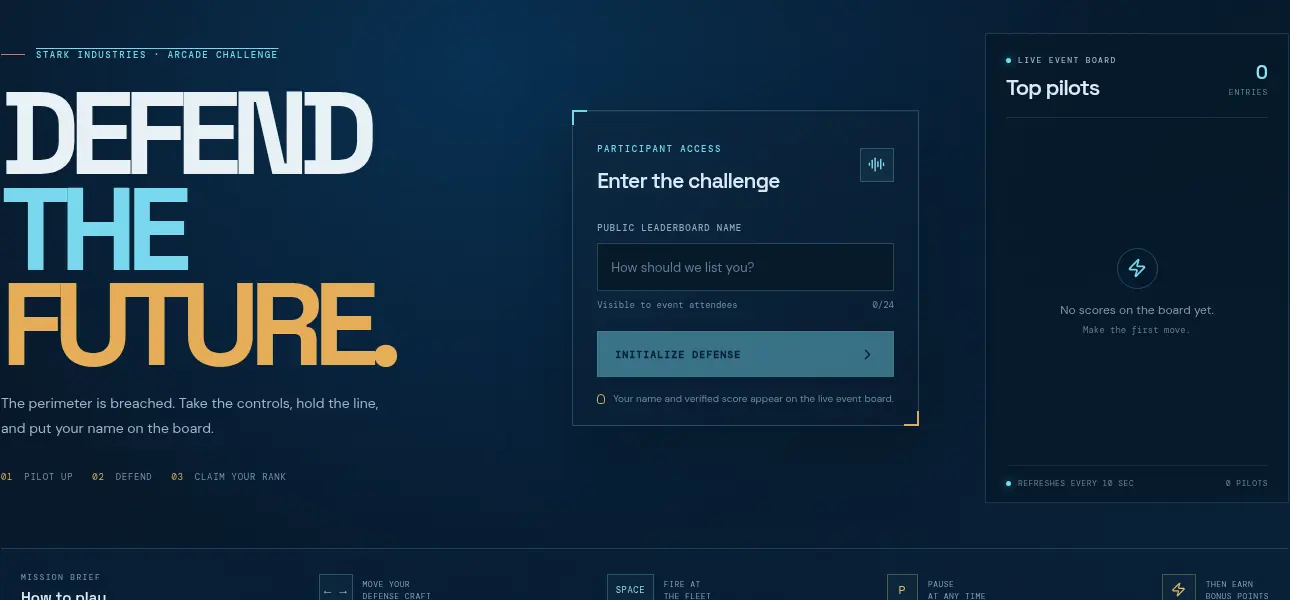
The short answer: review the challenge and the message
A trade show game works as a brand experience only when visitors can understand what to do and have a fair chance to notice what the product story has to do with it. A fast, impressive challenge can absorb attention while leaving the sponsor or product unclear. A slow, simple game can also fail if the visitor has no reason to continue. There is no universal difficulty level that solves this. The useful job is to test the game, the brand connection, and the product explanation as separate things.
Six common design reviews help: clarify the first instruction; remove unrelated copy from a fast round; give the product a real role; keep the leaderboard from becoming the only story; make controls accessible; and plan a natural conversation after play. These reviews make the experience easier to inspect and improve.
The examples are practical design scenarios, and the diagrams map review questions for use before production.
Attention is not brand or product memory
A visitor can focus on dodging an obstacle, notice a flashing score, and still be unable to say who made the game or what the product does. “Attention” itself can mean looking at a screen, following a rule, noticing a cue, remembering a name, or understanding a product idea. Those measures should not be collapsed into one claim.
Controlled advergame experiments examined brand–game goal fit and rule orientation in relation to brand attention and memory; one used a 15-minute game with student gamers (Sreejesh, Anusree, & Ponnam, 2018). A separate study examined cognitive demand and interactivity in relation to gamers’ brand attention and memory (Sreejesh & Anusree, 2017). These settings inform prototype questions; event conditions require direct testing.
General memory research also cautions that a striking element can become central while surrounding detail is less accessible, depending on task and encoding conditions (Kensinger, Garoff-Eaton, & Schacter, 2007). A booth game therefore needs its own test: what did people notice, what did they remember later, and what did they infer about the product?
Use precise language in the brief. “We want a high-energy game” is a creative preference. “We want visitors to identify one approved product capability after play” is a testable objective. The second still requires a measurement plan and does not promise the result.
Six design reviews that can restore the story
Review these problems in a playable prototype rather than only in a polished screenshot. The changes are practical starting points; audience testing decides whether they help.
Scroll horizontally to read each review →
| Review | What can go wrong | Possible fix | What to test |
|---|---|---|---|
| 1. Instructions | Visitors cannot tell what to do, so staff has to coach every first move. | Use one plain-language verb and show the control beside it. Reveal more only when needed. | Can a new visitor begin without explanation? Can they say the objective in their own words? |
| 2. Speed and unrelated copy | A rapid round includes long product text the player cannot read while moving. | Keep active play visually simple. Put approved product context at a calmer start, pause, or finish moment. | Can players notice the message without missing the action? Does the text remain readable at booth distance? |
| 3. Weak brand link | A logo appears, but nothing in the objective or feedback relates to the product story. | Give one approved product idea a meaningful role, or describe the game honestly as a branded attention piece. | Afterward, can visitors identify the sponsor and explain the intended product connection separately? |
| 4. Leaderboard dominance | The high score becomes the only remembered outcome and pressures visitors to compete. | Make participation optional, show a clear ending, and keep the product explanation visible outside the ranking. | Do visitors understand the game without ranking? Can they opt out of public naming? |
| 5. Inaccessible controls | Success depends on rapid reactions, tiny targets, sound, or one input method. | Offer clear controls, pause/exit, readable contrast, and an alternate way to watch or engage where the format supports it. | Can people with different input needs understand the options? Is play possible without hearing? |
| 6. Missing conversation bridge | The game ends on a score screen and staff do not know what to say next. | Add a short open question tied to the product idea and a direct option to see the real product demo. | Does the question invite a useful answer without treating play as qualification? |
Do not solve every failure by adding instructions. A long onboarding sequence can create a new barrier. First check whether the game’s objective is too abstract, the screen has competing priorities, or the intended audience needs a different interaction. A simpler mechanic can be a stronger product decision.
A cluttered screen and a clearer alternative
The left side below intentionally shows a conceptual clutter problem: many messages compete during active play. The right side separates the action from a short message and a staff question. This is an original design illustration, not a screenshot, eye-tracking result, or measured comparison.
On small screens, scroll horizontally to read every screen label.
In the clearer concept, the active challenge has the visual priority. Product language appears at a moment when the player can read it, and the booth team has a question ready. A visitor can still choose to watch or ask about the product without completing a round.
A non-numeric attention map
This map separates what the team hopes a visitor will notice from what it must measure. It uses no percentages, scores, or research data.
On small screens, scroll horizontally to read every diagram label.
Do not assign numbers to these boxes before you know how they will be collected. If a team later tracks responses, define the sample, prompt wording, timing, and handling of unsure answers. A conceptual map must not be presented as an attention result.
Why there is no universal ideal difficulty
“Make it easy” and “make it challenging” are both incomplete instructions. A very simple game may be accessible but fail to express the product story. A difficult game may be compelling to a confident player and discouraging to someone who has one minute between meetings. The right level depends on audience, controls, purpose, context, and how the team will handle a visitor who does not finish.
There is no universal difficulty optimum. A complex mechanic may use attention that a product message also needs, so test a prototype with the intended audience and assess game clarity and product comprehension separately.
Educational research also warns against treating a participant’s confidence as a direct measure of learning. A randomized study in two introductory physics course units found that students in active-learning classes reported feeling less learning while performing better on an immediate test than students in passive lecture settings (Deslauriers et al., 2019). That classroom result is not a trade-show game study, but it illustrates why “that was fun” cannot answer every question about understanding.
Use progressive disclosure: show one essential rule, let the player begin, and introduce optional detail only when needed. Offer practice or a low-stakes first move. Make a noncompetitive route available. Ensure the screen communicates an ending even if a visitor stops early. If the product idea only appears after a perfect score, the game has made the message conditional on skill.
Test with people who are not on the project team. Ask them to start without assistance, describe what they believe the objective is, and explain the product connection afterward. Compare how different visitors use the controls. A small usability test can reveal confusion; it does not estimate event-wide memory or sales.
Three different playtests: game, brand, product
One playtest cannot answer every design question. Run a game-clarity check, a brand-identification check, and a product-message check with distinct prompts.
- Game clarity: “What would you do next?” Watch for a first action without coaching. Ask whether the controls feel predictable and whether the ending is clear.
- Brand identification: After play, ask “Who provided that experience?” Do not offer a list until after an unaided answer. Then, if useful, check recognition separately.
- Product comprehension: Ask “What do you think the product helps a team do?” and “Which part of the game suggested that?” Compare responses against an approved rubric, not a desired slogan.
Record the version, audience, instructions, display setup, prompt, and timing. If staff explained the product before the question, record that. Do not infer brand memory from a player who has already seen the logo in the booth or encountered the company at an earlier event. If you need delayed recall, plan a separate consent-based study and state its limits.
Ask the product team to review the metaphor before testing with visitors. A visitor may interpret a game in a way the creative team did not expect, but the test cannot fix a claim that the client has not approved. Identify which words, images, and consequences need legal or subject-matter review before launch.
For accessible design, invite feedback from people with different input needs where feasible. Offer pause, a clear exit, readable instructions, and a way to understand the game without sound. Avoid public shame for low scores or a forced leaderboard name. These are practical inclusion choices; they do not claim a particular business return.
A practical design review table
Use this shorter review at a concept meeting. It keeps the team focused on a specific observation rather than a vague rating such as “engaging.”
Scroll horizontally to compare review questions →
| Layer | Question | Evidence to collect | What not to infer |
|---|---|---|---|
| Game | Can the visitor start, understand, and finish or exit? | Observed first action, questions, pauses, and usability feedback. | That an easy game teaches a message. |
| Brand | Can the visitor name the sponsor without a hint? | Unaided recall, then a separate recognition prompt. | That a logo viewed equals later recall. |
| Product | Can the visitor explain the intended capability? | Open-ended answer reviewed against an approved rubric. | That a high score or positive reaction proves understanding. |
| Conversation | Did staff and visitor have a relevant exchange? | Human-coded conversation or agreed CRM stage. | That a play, opt-in, or email is a qualified opportunity. |
Evidence limits and what to test at an event
Brand-memory experiments, educational interventions, and classroom studies use different tasks, samples, and measures. They can point to questions about cognitive load, goal fit, and whether a message is noticed, but they do not establish a universal game difficulty or trade-show outcome. Even measured brand recall in an advergame is not the same as product understanding, lead quality, or sales.
Scene-memory experiments found that emotional objects and surrounding details did not always receive equal memory priority, depending on the task (Kensinger et al., 2007). Test the actual product connection with the intended audience; visual drama alone does not establish recall.
A small booth pilot can test clarity, accessibility, staff handoff, and whether visitors understand the proposed metaphor. If the client needs an estimate of brand lift or sales attribution, use a research and analytics design appropriate to that question. Report what the evidence shows and what it leaves unknown.
Trade show game design checklist
- One clear instruction appears before or at the first action.
- Active play does not compete with unreadable product copy.
- The brand and product connection has a role beyond a logo placement, or the scope is described honestly.
- A leaderboard is optional and does not replace the product message.
- Controls, sound, contrast, pace, pause, and exit work for varied visitors.
- A staff question connects the game to a real product conversation.
- Game, brand, product, conversation, and sales outcomes stay separate.
- Claims, mechanics, data use, and event setup have appropriate approval.
Frequently asked questions
How difficult should a trade show game be?
There is no universal optimum. Set a level that fits the audience, time, controls, and message, then test it with people outside the design team. Do not make a product explanation available only to the highest scorer.
Can a fast game still explain a product?
Possibly, if the action is clear and the product idea has a meaningful, approved role. Long copy during fast play may be hard to read; consider a start or finish moment and a staff handoff.
Does a leaderboard help brand recall?
A leaderboard can create a visible competition, but it can also make the score the main memory. Test whether visitors still identify the sponsor and explain the product idea, and offer a noncompetitive route.
Does a high score show product knowledge?
No. It shows performance under the game’s rules. Product knowledge requires a separate question and a defensible way to evaluate the answer.
How can we test sponsor and product recall?
Ask separate open-ended questions, set the timing and rubric beforehand, report who responded, and distinguish immediate from delayed answers. A small usability sample is not an event-wide lift estimate.
References
- Sreejesh, S., & Anusree, M. R. (2017). “Effects of cognition demand, mode of interactivity and brand anthropomorphism on gamers’ brand attention and memory in advergames.” Computers in Human Behavior, 70, 575–588. https://doi.org/10.1016/j.chb.2017.01.033
- Sreejesh, S., Anusree, M. R., & Ponnam, A. (2018). “Does game rules work as a game changer? Analyzing the effect of rule orientation on brand attention and memory in advergames.” Computers in Human Behavior, 81, 325–339. https://doi.org/10.1016/j.chb.2017.12.034
- Kensinger, E. A., Garoff-Eaton, R. J., & Schacter, D. L. (2007). “Effects of emotion on memory specificity: Memory trade-offs elicited by negative visually arousing stimuli.” Journal of Memory and Language, 56(4), 575–591. https://doi.org/10.1016/j.jml.2006.05.004
- Deslauriers, L., McCarty, L. S., Miller, K., Callaghan, K., & Kestin, G. (2019). “Measuring actual learning versus feeling of learning in response to being actively engaged in the classroom.” Proceedings of the National Academy of Sciences, 116(39), 19251–19257. https://doi.org/10.1073/pnas.1821936116