
Experiential marketing psychology / Research & design
Memorable Brand Activations: How Emotion, Attention, and Games Shape Recall
Design a relevant moment by connecting the visitor’s action, the product meaning, and the sponsor identity. This guide separates experience, brand, and product memory, then shows how to test each one.
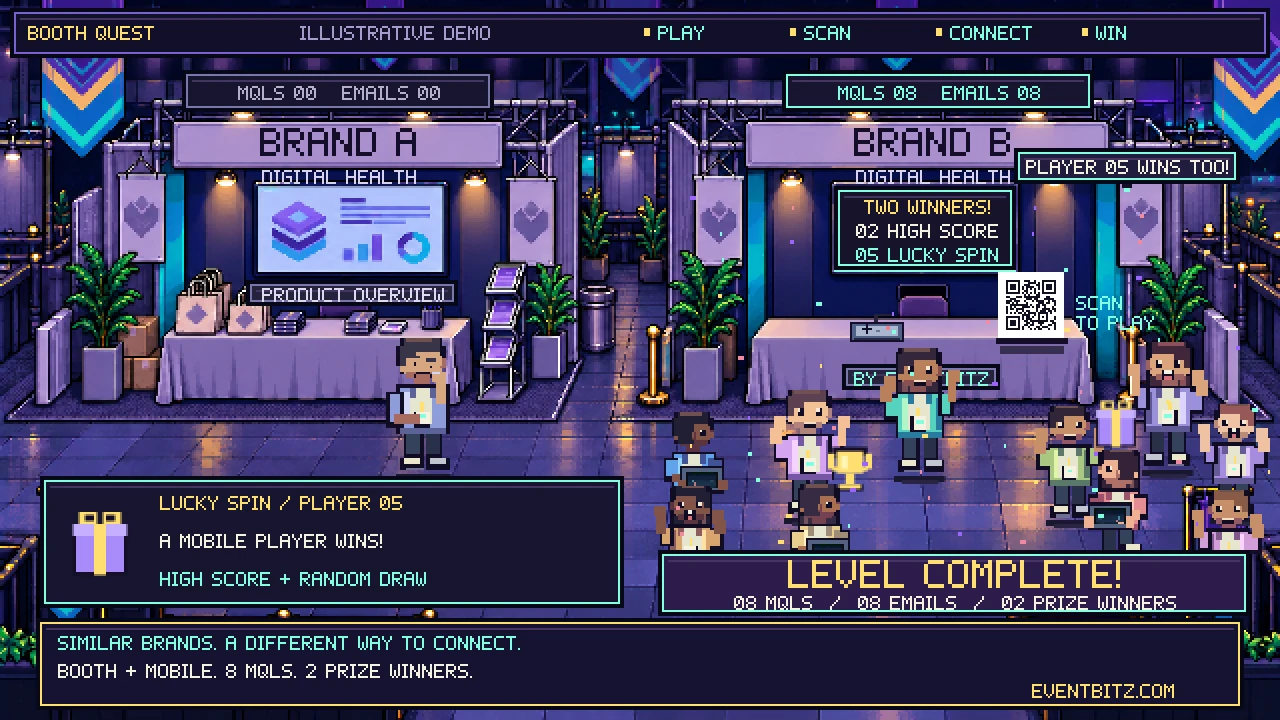
The short answer: design for the memory you want
A memorable brand activation connects the visitor’s central action with a clear product meaning and sponsor identity. Memory research gives marketers useful questions about attention and significance; those questions can shape the experience and the way a team evaluates it.
Start by deciding what the visitor should remember: the experience, the sponsor, or the product idea. Then make that meaning easy to notice and ask people what stayed with them.
Experience, brand, and product memory are different
Event teams often use one word, “recall,” for several outcomes. That can hide a basic measurement problem. A visitor who says “I played a game at the booth” remembers an activity. A visitor who names the company remembers the sponsor. A visitor who can describe what the product does remembers a message. A visitor who later asks a salesperson about a relevant use case may have taken another step, but even that does not establish that the activity caused a purchase.
Those outcomes overlap, but one is not a substitute for another. A photo-worthy installation might create strong experience memory while weakly connecting the moment to a product. A detailed demo might communicate a feature without feeling distinctive. A small, well-timed interaction might be easy to remember but carry little commercial relevance. Treating these as separate keeps a creative brief honest and gives a team a fairer way to learn.
- Experience memory: Can someone describe what they did, saw, heard, or felt?
- Sponsor memory: Can someone identify the company responsible for that experience?
- Product memory: Can someone state the product idea or use case that the experience was meant to express?
- Conversation: Did a real exchange happen, and was it useful to the visitor and staff member?
- Commercial follow-up: Did a separate sales process produce a qualified next step or outcome? This needs its own definition and evidence.
A concise post-play question can reveal more than a score. Ask, “What do you think that game was showing?” before naming the product. Then ask, “Which company’s booth did you play at?” Do not lead the visitor toward the desired answer. Record each response using a predetermined rubric, and allow “not sure” as a valid answer. If the audience is too busy to answer, do not turn a quick interaction into a survey they did not agree to take.
Be careful with “brand recall” as a phrase. Unaided recall asks a person to name the brand without a list; recognition asks whether they recognize it from choices. Both can be useful, but they answer different questions. A person can recognize a logo after seeing it on a screen without remembering the company spontaneously. A person can remember a product category while not recalling the exact brand. Report the prompt and timing alongside the result.
The distinction matters for experiential marketing psychology because a feeling or vivid image may be easier to remember than its source. Emotional significance can change how details are encoded, so teams should check whether visitors remember the sponsor and product meaning as well as the experience.
How emotion can shape attention and memory
McGaugh’s review describes how arousal-related processes can influence memory consolidation (McGaugh, 2013). In controlled scene-memory experiments, emotionally salient objects were sometimes remembered at the expense of background detail, depending on the task (Kensinger, Garoff-Eaton, & Schacter, 2007).
For a booth designer, that suggests a question rather than a formula: what is likely to become central, and what will fade into the background? If the game’s fastest movement, brightest color, or largest score dominates the screen, is the product message still legible? If the booth team explains a feature only after the game ends, does the visitor have a reason to connect that feature to what just happened? These are design hypotheses to test, not effects established by the memory studies.
Curiosity may also shape information-seeking. In a lab trivia study, people who reported high curiosity about a question remembered its answer better; incidental neutral faces encountered during anticipation showed a smaller memory effect. The study used fMRI and memory tests, not a branded activation, and dopamine itself was not directly measured (Gruber, Gelman, & Ranganath, 2014). A relevant question may invite attention; whether sponsor information is remembered remains a separate question to test.
Advergame experiments examined how rule orientation and brand–game goal fit related to attention and brand memory; one study used student gamers and a 15-minute game (Sreejesh, Anusree, & Ponnam, 2018). This makes message fit a useful question during concept review.
A practical attention-to-recall map
This conceptual map is a planning aid, not a measured funnel or a validated model. It separates the moments a team can design from the outcomes it must test.
On small screens, scroll horizontally to read every diagram label.
Use the map as a quick review with marketing, product, sales, and the exhibit team. “Notice” asks whether a visitor can understand the invitation from the aisle. “Interpret” asks whether the objective is clear before staff has to explain it. “Connect” asks what feature, customer problem, or workflow the action is meant to make more concrete. “Test” asks what evidence would distinguish an enjoyable round from a remembered product message.
At each step, identify a possible break. A person might notice the sound but not understand the rules. They might understand the game but see no connection to the product. They might make that connection while playing and forget the sponsor after walking away. The map makes these failures visible before a production team invests in polish.
A hypothetical product story, from incident to recovery
Consider a fictional monitoring-software company that wants visitors to understand how a team notices an outage, sorts useful signals from noise, and restores service. The storyboard shows how to translate that product idea into a player action.
On small screens, scroll horizontally to read every storyboard label.
- Start with the visitor’s problem. An operations leader may care about interrupted service, missed context, or unclear ownership. The brief should ask which problem is both important to the audience and approved for the event message. “Make the product exciting” is not a usable objective.
- Choose one product idea. The team might want to show that related signals can help someone identify where to investigate. The game should not claim to reproduce an actual incident, model a real customer environment, or prove that a buyer would resolve an outage faster.
- Give the idea a visible action. A player could collect three types of abstract signal, avoid distracting noise, and reach a recovery point. Each item needs an approved meaning. If the action merely rewards quick movement, the product message should not be inferred from the score.
- Show feedback that matches the message. A screen might briefly show which signals were collected and which product idea they represent. The feedback should be accurate and understandable, not a fabricated performance metric or an unverified promise.
- Invite a conversation after play. A staff member could ask, “Which signal would your team want to see first when something changes?” The visitor’s answer can lead to a relevant demo. The question is an opening, not a qualification score.
- Check memory separately. Later, ask what the interaction represented, which company hosted it, and what product capability the visitor recalls. A result should describe the sample, question wording, timing, and nonresponses.
The hypothetical remains useful only if the mechanic clarifies the product rather than adding an unrelated obstacle. A clever “incident recovery” game could still confuse people if the signals are invented jargon, the display is too fast to read, or the staff member has to correct the metaphor. Review the story with product experts and a few people who resemble the intended audience before polishing its art.
Swag, demos, games, and combinations
There is no universally best activation format. Useful swag can serve a practical need and act as a reminder later. A product demo can answer specific questions with depth. A game can invite a short, visible action and create a reason to talk. Combining them may make sense when each part has a clear role, but more components also add staffing, space, access, and follow-up demands.
Scroll horizontally to compare every column →
| Format | Useful when | Possible limitation | Question to test |
|---|---|---|---|
| Useful swag | The item solves a small practical need or has a reasonable life after the show. | Taking an item does not show product understanding or sponsor recall. | Would the intended audience choose and use it without an event incentive? |
| Product demo | A visitor needs to see a real workflow, interface, or product answer. | A passive or long walkthrough can be hard to enter from a busy aisle. | Can the visitor ask a question and see the relevant capability clearly? |
| Game | A short, voluntary action can make one idea more concrete or open a conversation. | Movement, competition, or scores can overshadow the message. | Can a visitor explain what the action represented afterward? |
| Combination | The game invites a turn, a demo answers a real question, and a practical item has independent value. | Multiple stations can create queues or blur which activity produced an outcome. | Can staff explain each step and measure its role separately? |
Do not dismiss giveaways or assume a game is more memorable. A useful item may fit one audience; a detailed demo may help a technical buyer more than an entertaining interaction. Choose by the visitor’s need, staff response, and what the organization can support after the show. If formats are combined, explain each step and any data or prize requirement before the visitor commits.
Make the memorable action fit the message
A brand activation feels less like an ad pasted onto a game when the product idea has a meaningful job inside the rules. A service that helps people prioritize could be represented by choosing what to address first. A logistics workflow might involve routing a parcel through choices that reveal a tradeoff. A software platform might turn signal collection into a visible objective. These are conceptual mappings, not claims that the product performs exactly like the game.
Write down the link in a sentence: “The player does this, which makes this product idea easier to discuss because this consequence is visible.” If the sentence cannot be completed without stretching the metaphor, use a simpler game with tasteful branding or keep the product story in a conventional demo. A custom mechanic is not automatically better than a straightforward branded format.
Give the visitor a way to notice the sponsor in the same experience. That may mean a clear opening screen, a product-specific visual world, a branded feedback moment, or a staff handoff that connects the action to the product. Do not overload every frame with copy. The goal is a coherent connection, not maximum logo repetition.
A practical brief for a memorable activation
A useful brief makes the team choose what the experience is for and what it is not expected to prove. It can be a one-page working document, but the questions need specific answers before production starts.
- Name the audience and setting. Who is walking by, what do they already know, and how much time might they have? Include the booth footprint, display position, noise, traffic, language, accessibility needs, and expected staff capacity.
- Choose one product message. State the idea in plain language a visitor could repeat. Separate approved product claims from marketing metaphor. Identify which product or legal reviewers must approve the experience.
- Define the player action. Explain what the attendee does in one sentence. The first instruction should be observable and the first turn should be understandable without a long staff explanation.
- Explain the connection. Write the product-to-mechanic sentence from the prior section. If it is weak, decide whether to redesign, simplify, use a branded template, or move the story into a demo.
- Plan feedback and a handoff. Decide what the screen says at the end, who speaks next, and what a staff member can ask without making the interaction feel like a quiz or sales ambush.
- Set measurement boundaries. Choose whether to count starts, completions, registrations, opt-ins, questions, booked follow-ups, or later commercial outcomes. These are not interchangeable. Define the data owner, notice/consent, retention, and follow-up process.
- Test access and throughput. Confirm readable instructions, keyboard/touch alternatives where intended, accessible controls, a play-or-watch option, and a graceful way to step away. Estimate a queue using the real round length and observed staffing rather than an untested ideal.
- Write a nonclaim. State what the experience does not prove: for example, a high score is not product proficiency, a completed round is not a qualified lead, and an enjoyable moment is not a sales result.
A useful concept review can show the starting screen, a sample play moment, the product connection, the ending, and the staff’s next question. That is more informative than approving a logo and color palette before anyone knows what the attendee will actually do.
A proposed recall test that separates outcomes
There is no single “memory score” that answers every question. Before the show, state what counts as a correct answer and who will collect it. If the goal is sponsor recall, do not use only a game score. If the goal is product comprehension, do not infer it from time spent at the booth. If the goal is a sales conversation, track the conversation in the sales process rather than relabeling every registration as qualified pipeline.
- Define the prompt. For unaided sponsor recall, ask “Which company’s booth did you visit?” without offering names. For product memory, ask “What do you think that product helps a team do?” The question should not contain the answer.
- Define the time. An immediate answer tests a different interval than a later follow-up. If testing delayed recall, choose a reasonable time window, record it, and do not assume that one delay represents every buying cycle.
- Define the sample. Record who was invited, who responded, and who declined. Report the denominator and relevant context. A self-selected group of people who enjoyed the game may not represent everyone who passed the booth.
- Code consistently. Have reviewers use an agreed rubric for correct, partly correct, incorrect, and unsure answers. When feasible, remove identifying information from response text before independent coding.
- Keep outcomes separate. Report experience recall, sponsor recall, product message comprehension, voluntary participation, opt-in contacts, qualified conversations, booked demos, pipeline, and attributable revenue as different measures.
- Compare carefully. If a comparison is important, plan it before the event with a defensible design and the right data support. A simple before-and-after count or a handful of interviews can provide useful operational feedback but cannot isolate the game as the cause of a later sale.
A short practical test might invite a sample of consenting attendees to answer two open prompts immediately and a subset again after a defined interval. The project team could compare answers to the product message they intended to communicate, report the response rate, and note what was not tested. This proposal is not a validated EventBitZ method or a guaranteed research design; a formal brand-lift study may require a specialist, a comparison group, and a larger sample.
Do not send names, emails, company names, or free-text answers into analytics event attributes. Collect contact data only through a clearly described, approved inquiry or opt-in process. Keep privacy and research consent separate from a leaderboard or prize mechanic. Ask the client’s privacy, legal, and event teams to approve the actual data handling before launch.
What the evidence does not establish
Memory research helps explain why significance, attention, task, and context matter. Curiosity experiments help frame voluntary information-seeking. Advergame studies can inform hypotheses about the relationship between game goals and brand integration. Yet these sources use laboratory scenes, trivia tasks, student gamers, controlled advergames, or other settings unlike a noisy, time-limited trade-show aisle. They do not establish that a particular EventBitZ game creates sponsor recall, qualified leads, pipeline, or sales.
Educational serious-game reviews address learning and retention in diverse instructional contexts. They are not evidence that a short event game transfers product knowledge. A game can be enjoyable and still fail to teach; an attendee may learn something without enjoying it; a clear explanation may work better than a game. Measure the outcome you care about instead of borrowing a result from a different task.
Even a well-run pilot remains conditional. Audience mix, message familiarity, booth location, competing traffic, staff behavior, accessibility, round length, and follow-up can all change what happens. Keep claims proportional to the design and data. “We observed these responses among this sample at this event” is more trustworthy than “games make brands unforgettable.”
For research on emotional memory, curiosity, and advergames, see the linked references. For cost scope and event measurement, see the custom game cost guide and trade-show game ROI guide.
Planning checklist
- Choose one visitor and one product idea.
- Write the action-to-message connection in plain language.
- Keep sponsor identity visible without crowding every screen.
- Offer a voluntary way to play, watch, ask, or continue walking.
- Make the first action and controls understandable.
- Give booth staff a relevant, non-leading follow-up question.
- Measure experience, sponsor, product, conversation, and sales outcomes separately.
- Describe samples, timing, opt-outs, and uncertainty.
- Label illustrative scenes, scores, and hypothetical product mappings.
- Review claims, privacy, accessibility, staffing, and event setup before production.
Frequently asked questions
Does an emotional activation make a brand more memorable?
Not automatically. General memory research suggests arousal can influence consolidation, but emotional material can also draw attention away from background details. Test sponsor and product recall separately rather than assuming that a strong feeling transfers to the brand.
Are games more memorable than useful giveaways?
There is no universal winner. A useful giveaway may suit the audience; a game may make one idea tangible; a demo may answer the best question. Choose by the visitor need, product story, booth operation, and evidence you can collect.
How can we tell whether visitors remember the product?
Ask an open-ended product question, define an answer rubric, record when you asked it, and report who responded. If you also want sponsor recall, ask that separately. Do not treat a score or an email registration as proof of comprehension.
Can a high game score be called a qualified lead?
No, not by itself. A score describes game performance. Lead qualification requires a separate, clearly defined business process and relevant human context. Do not infer purchase intent from play alone.
Should every activation collect email addresses?
No. Registration can add friction and requires transparent purpose, consent, data ownership, and follow-up. Decide whether a contact is genuinely needed for the experience. If it is optional, make the choice clear and allow play without it where the approved system permits.
References
- McGaugh, J. L. (2013). “Making lasting memories: Remembering the significant.” Proceedings of the National Academy of Sciences, 110(Supplement 2), 10402–10407. https://doi.org/10.1073/pnas.1301209110
- Kensinger, E. A., Garoff-Eaton, R. J., & Schacter, D. L. (2007). “Effects of emotion on memory specificity: Memory trade-offs elicited by negative visually arousing stimuli.” Journal of Memory and Language, 56(4), 575–591. https://doi.org/10.1016/j.jml.2006.05.004
- Gruber, M. J., Gelman, B. D., & Ranganath, C. (2014). “States of curiosity modulate hippocampus-dependent learning via the dopaminergic circuit.” Neuron, 84(2), 486–496. https://doi.org/10.1016/j.neuron.2014.08.060
- Sreejesh, S., Anusree, M. R., & Ponnam, A. (2018). “Does game rules work as a game changer? Analyzing the effect of rule orientation on brand attention and memory in advergames.” Computers in Human Behavior, 81, 325–339. https://doi.org/10.1016/j.chb.2017.12.034