
Custom branded games / Research & design
Brand Activation Games: Turn Your Product Story Into Something People Can Play
A strong brand activation game gives the player an action that helps make a product idea understandable. Start with the audience and message, then choose a mechanic that makes that idea playable.
The short answer: connect action to product meaning
A brand activation game is a short playable experience designed for an event, campaign, or product story. Begin with the visitor’s action: what can they do that makes one product idea easier to notice, explain, or discuss? A clear game response can set up a useful conversation with booth staff.
This guide includes eight hypothetical mechanic patterns, a fictional brief-to-concept walkthrough, a decision matrix, and an annotated gameplay frame. The examples are starting points for a product and audience review.
When simple branding is enough, and when it is not
A familiar game with a clear objective can be the right choice when the event needs a fast turn, the product message belongs in the surrounding conversation, and a custom story would add complexity without adding meaning. A configurable format may be useful when a team wants to adjust colors, questions, prize rules, or event language while retaining a familiar loop. Original custom work is more relevant when a product-specific action, sequence, or tradeoff needs to be part of play itself.
These are different scopes, not a ladder where one is automatically superior. A simple branded game may be easier to understand in a busy booth. Original work needs stronger product input, review, and playtesting. If a product story can be explained more clearly in a conventional demo, the game should not replace that demo.
Ask the team to describe the visitor’s action without naming the art style. “Move left and right to collect items” explains a mechanic. “Sort incoming requests by urgency so a team can see a prioritization tradeoff” explains a product-related action. The second still needs a review: does that action genuinely represent an approved product idea, or is the connection only a slogan placed over unrelated play?
Controlled advergame experiments examined game rules and brand–game goal fit in relation to brand attention and memory; one used student gamers for a 15-minute game (Sreejesh, Anusree, & Ponnam, 2018). For a concept review, ask whether the player’s objective reinforces the product story.
A message-to-mechanic alignment model
Use this sequence to make an early concept review concrete. Each link should make sense to a product expert and to someone who has never seen the product before.
On small screens, scroll horizontally to read every diagram label.
Audience: be specific about who is invited and what they already know. Message: select one approved idea rather than a list of features. Mechanic: give the player an action that makes the message relevant. Feedback: show a consequence that the game can truthfully represent. Handoff: invite the visitor to connect the metaphor to their own context.
A concept fails the alignment check if its game loop is unchanged by the product story. A space shooter that uses a logo but never gives the logo, product, or audience a role may still be a useful attention piece; call it a branded game and do not overstate the product learning. If the team wants a stronger product connection, decide what the player can do differently and why that action belongs in the world.
Eight hypothetical mechanics, with the tradeoffs
The following ideas are starting points for a workshop. The fictional products and audience needs are illustrative. A mechanic should be redesigned or discarded if the product mapping feels forced, the controls exclude visitors, or the round cannot fit the booth’s actual staffing and throughput.
Scroll horizontally to read each mechanic →
| Mechanic | Audience / message | Player action | Visible consequence | Constraint | Staff question |
|---|---|---|---|---|---|
| Route planner | Operations teams; routing involves tradeoffs. | Choose a route through stops with changing priorities. | The route shows which need was addressed first. | A simplified route is not logistics advice or a system simulation. | “What makes routing difficult in your environment?” |
| Signal sorter | Software buyers; related signals support investigation. | Collect a small set of relevant signals and ignore noise. | A summary names the chosen signals, not a diagnostic result. | Use approved, understandable terms; avoid fake monitoring metrics. | “Which signal would your team want to see first?” |
| Capacity balancer | Planning teams; demand and capacity need coordination. | Move resources between lanes as demand changes. | The board shows a visible balance or uncovered request. | Do not imply the score predicts real capacity planning. | “Where do handoffs tend to create friction?” |
| Sequence builder | Product teams; an ordered process can clarify a workflow. | Place steps in a sequence or repair one missing link. | The sequence resolves into a readable process map. | Only use steps approved by subject-matter reviewers. | “Which step takes the most explanation today?” |
| Risk spotter | Security teams; choices can expose a tradeoff. | Choose what to protect or investigate in a fictional scenario. | The next scene responds to the selected priority. | Keep the scenario abstract; do not present it as security guidance. | “What would you want to know before deciding?” |
| Color-match collection | Broad event audience; a familiar game can make a turn easy to enter. | Match groups of pieces or collect a visible set. | A clear animation confirms a match or completed collection. | Product meaning may remain in the follow-up rather than the game. | “Would a quick overview or deeper demo be more useful?” |
| Question-and-reveal | Visitors exploring a new category; one question helps reveal a concept. | Predict an outcome, then choose to reveal the explanation. | The reveal shows the approved answer and its context. | Do not shame wrong answers or hide essential information. | “What surprised you about that explanation?” |
| Cooperative relay | Small teams; a handoff is part of the story. | Players pass a token or alternate actions toward one goal. | The shared board shows contributions, not a sales outcome. | Keep a solo route and do not require social participation. | “Where does this kind of handoff happen at your team?” |
A leaderboard, question set, or prize is an event feature, not a product story by itself. The brief should say what the visitor understands, chooses, or discusses, and the implementation scope should describe only the capabilities actually included.
A complete hypothetical brief-to-concept walkthrough
Imagine a fictional workflow platform that helps a facilities team respond to requests from several buildings. The event audience includes operations managers and potential partners. The company wants visitors to understand that requests can be prioritized and routed, but it does not want the game to act as a real scheduling tool. This example is hypothetical and makes no claim about a customer or product result.
- Brief: The approved message is “Teams can see incoming work, decide what needs attention first, and understand where a handoff is waiting.” The event team notes that visitors have about a minute to interact, the booth has one shared display, and staff can answer a follow-up after the round.
- Audience question: “How does your team decide which request needs attention first?” This is open-ended and does not ask a visitor to disclose confidential incident details.
- Mechanic: The concept is a fictional route board. The player chooses which request to address, then moves a token through a simplified set of locations. A new request may appear, creating a visible tradeoff rather than an “optimal answer.”
- Feedback: At the end, the game shows the path and the choices made. It does not calculate a real efficiency score, make a service-level promise, or claim that a visitor has mastered a workflow.
- Staff handoff: A staff member asks which tradeoff seemed most familiar, then offers a conventional product demo if the visitor wants to see how the actual platform handles routing. The visitor can decline without losing a prize or access.
- Review: Product specialists check terminology. A visitor representative tests whether the goal is clear. The legal or privacy reviewer checks any data collection and prize rules. A production test checks the display, sound level, controls, and real turn duration.
If a participant reads the route as a simulation, the screen should say that it is illustrative. If the action is too difficult to understand, reduce the number of stops before adding instructions. If players only remember the maze, ask whether the product connection needs to be in the feedback or whether a simple branded game plus a staffed explanation is the more honest scope.
Choose a mechanic that fits the booth
Product fit is only one constraint. The booth itself determines whether a mechanic is usable. Consider the aisle sightline, audio, queue space, staffing, screen position, prize policy, available power and network, language needs, expected play length, and how a visitor can leave. If the team needs a large explanation before a visitor can act, the game may be too complex for the setting.
Scroll horizontally to compare scope options →
| Option | Choose it when | Review focus | Do not assume |
|---|---|---|---|
| Lightly branded familiar format | The visitor needs a fast, familiar challenge and the product conversation happens with staff. | Brand visibility, instructions, round time, and the handoff. | That the game teaches or measures product understanding. |
| Configurable game | Questions, themes, colors, or event details need to vary inside an established mechanic. | Which options are included and how event content is reviewed. | That configuration automatically makes the mechanic product-specific. |
| Original custom game | A unique player action or consequence helps express a product story. | Scope, approvals, playtesting, accessibility, technical setup, and a clear nonclaim. | That original art or rules guarantee recall or sales. |
| Conventional demo | The visitor needs accurate product detail, a real workflow, or a direct technical answer. | Presenter, demo environment, questions, and follow-up. | That a game is needed for every conversation. |
For buyers comparing custom and configurable work, ask a vendor to show the actual playable mechanic before comparing a feature list. A theme, question bank, prize wheel, or leaderboard can be useful, but it should not obscure what the visitor does or what the staff team must operate. See the custom versus template game comparison and the current cost guide for scope questions.
Read an actual gameplay example
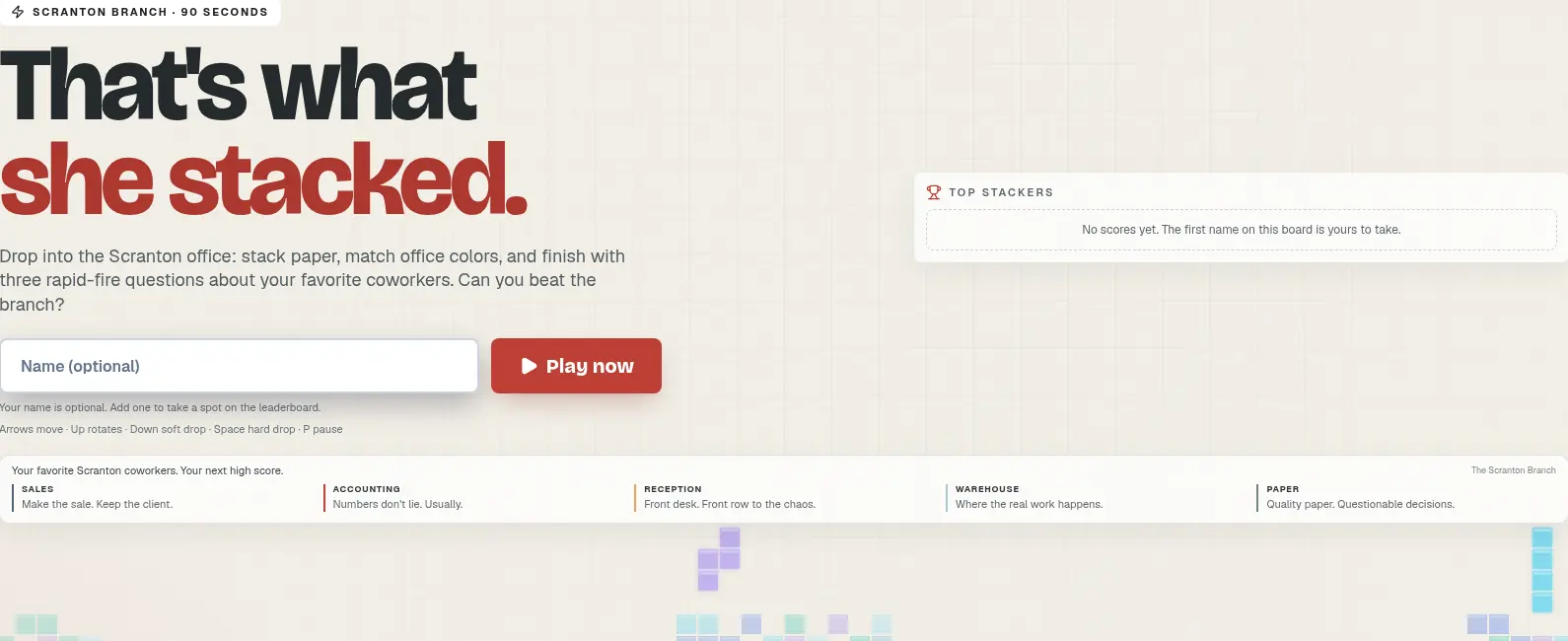
Look at the preview below as a mechanic, not as proof of an event outcome. The player moves falling pieces, chooses where to place them, and sees the board change. That is a clear action-feedback loop. A product-specific version could use a different original world and meaning, but only if the product mapping were approved and useful to the audience.
For an original brief, annotate the preview in words: what is the objective, which action is under the player’s control, what feedback appears, and where the product story would enter. Do not place an unverified brand name, logo, performance statistic, or customer claim into a proposed mockup. If a product mapping is still hypothetical, label it that way.
The booth team should be able to explain the game in one breath and the product connection in another. That gives the attendee a choice: play, watch, ask a question, or continue. The event interaction can be a starting point; it should not make a product demo or qualified sales conversation seem already completed.
Questions to ask before the game ships
Playtesting should separate the game experience from the brand and product message. Ask people who resemble the intended audience to try the prototype without coaching, then collect feedback with a neutral script.
- Game: Can the player tell what to do? Are the controls discoverable? Does the round end clearly? Is it possible to pause or leave?
- Brand: Who does the player think provided the experience? Which brand cue did they notice? Could another company have used the same screen unchanged?
- Product: What did the visitor think the product helps someone do? Which action in the game suggested that? What remains unclear?
- Booth operation: Can staff support the chosen format, keep the line moving, explain the rules, and run the actual setup?
- Access: Can someone engage without hearing sound, using a keyboard, standing in a particular position, or competing publicly? Are alternatives available?
What advergame studies can and cannot tell us
A controlled advergame study examined cognitive demand and interactivity in relation to gamers’ brand attention and memory (Sreejesh & Anusree, 2017). Use it to frame a prototype question about challenge and message, rather than as a universal difficulty rule.
A meta-analysis of serious games in educational settings reported learning and retention findings compared with conventional instruction, while its overall motivation result was not statistically significant (Wouters et al., 2013). Educational formats, repeated sessions, and measures differ from brief branded event play. That work does not show that custom branded games teach a product, produce qualified leads, or outperform demos at trade shows.
Research should inform the question, not dictate a promise. Ask whether the goal and mechanic fit, whether a visitor has enough attention for both play and message, and whether the staff handoff is useful. Then test those points in the actual setting. If the evidence is a small prototype review, report a prototype review. If the organization wants causal campaign evidence, it needs a more rigorous measurement design than a leaderboard count.
For a practical evaluation, report starts, finishes, opt-ins, product-comprehension answers, sponsor recall, qualified conversations, booked demos, pipeline, and attributable revenue separately. Define each before the event. A result at one stage does not prove the next stage occurred, and a game score should never be substituted for a commercial qualification rule.
Brand activation game checklist
- Choose one audience and one approved product idea.
- Write the player action and product connection in plain language.
- Decide whether a familiar branded format is enough.
- Make feedback accurate and do not present fictional scores as product results.
- Check that instructions, controls, accessibility, and round length fit the booth.
- Plan how a visitor can play, watch, ask, or leave.
- Give staff a short open-ended handoff question.
- Review content with product, legal, event, and privacy owners as needed.
- Test game clarity, brand attribution, and product comprehension separately.
- Report event evidence with its sample, context, and limitations.
Frequently asked questions
What is a brand activation game?
It is a game used in an activation or event to invite participation and support a brand or product conversation. The scope can range from a familiar branded format to an original mechanic built around an approved product story.
Does a custom branded game need an original mechanic?
No. A familiar mechanic may be easier to understand and may fit the event better. Original mechanics are most useful when the visitor’s action helps make a specific product idea concrete.
Can a game replace a product demo?
Usually it should not replace a demo that a visitor needs for accurate technical detail. A game can invite interest or help start an explanation; the product demo can answer deeper questions.
How do we measure whether the game worked?
Define the objective first. Measure play, understanding, sponsor recall, conversations, and commercial follow-up as separate outcomes. Do not call a high score a lead or infer sales from participation.
Can a game be built around a product launch?
Yes, if the launch message is approved, the mechanic fits the audience and booth, and the team can support the experience. Keep a conventional route for attendees who want product detail without playing.
References
- Sreejesh, S., Anusree, M. R., & Ponnam, A. (2018). “Does game rules work as a game changer? Analyzing the effect of rule orientation on brand attention and memory in advergames.” Computers in Human Behavior, 81, 325–339. https://doi.org/10.1016/j.chb.2017.12.034
- Sreejesh, S., & Anusree, M. R. (2017). “Effects of cognition demand, mode of interactivity and brand anthropomorphism on gamers’ brand attention and memory in advergames.” Computers in Human Behavior, 70, 575–588. https://doi.org/10.1016/j.chb.2017.01.033
- Wouters, P., van Nimwegen, C., van Oostendorp, H., & van der Spek, E. D. (2013). “A meta-analysis of the cognitive and motivational effects of serious games.” Journal of Educational Psychology, 105(2), 249–265. https://doi.org/10.1037/a0031311