
Product education / Research & design
Interactive Product Demos: How Scenario-Based Games Can Help Event Visitors Understand
Use a clear goal, meaningful choice, useful feedback, and a short reflection to help a visitor explore one product idea. This guide compares scenario-based games with conventional demos and suggests ways to check comprehension.
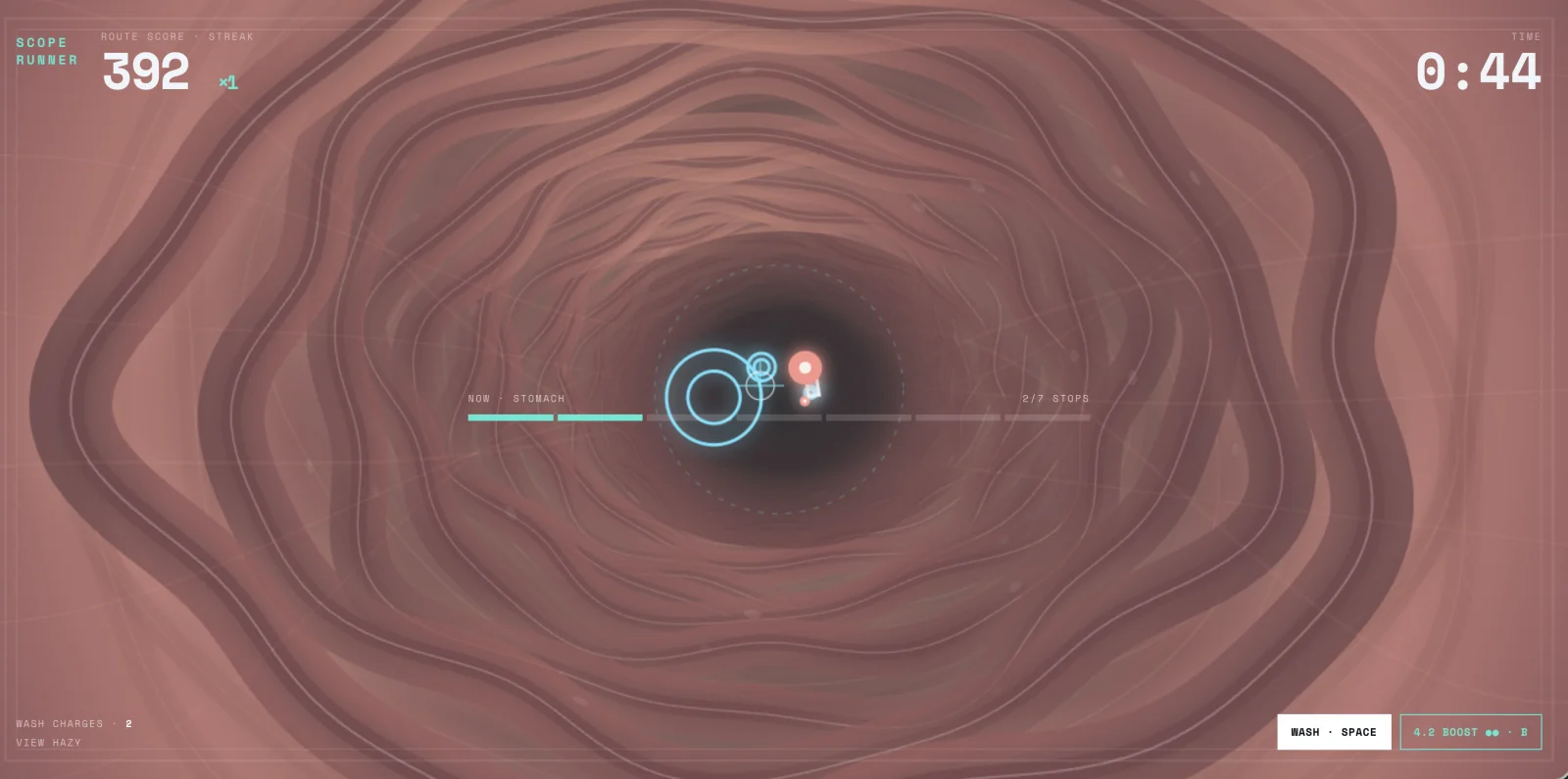
The short answer: let the visitor try one idea
An interactive product demo can help an event visitor explore a product idea by making a choice and seeing a consequence. A scenario-based game is most useful when the audience can understand the situation quickly, the choice reflects an approved message, and the feedback opens a real conversation. Use a conventional product demonstration when visitors need exact interface behavior or technical detail.
Use a four-part loop: state a goal, let the visitor choose, show relevant feedback, and invite reflection. Keep the scenario small. A real product can be complex; a one-minute booth interaction should not pretend to reproduce every workflow, risk, or decision. If the product story requires precise technical detail, a conventional demo or a guided conversation may be clearer.
The examples below are hypothetical. Any health-related scenario uses abstract workflow language and approved messaging only. None is medical advice, clinical training, a simulation of a real device, or evidence of treatment efficacy.
Gamification, serious games, and scenarios
These terms are related but not interchangeable. Gamification usually adds selected game elements such as points, progress, challenge, or feedback to an activity that is not itself a complete game. A serious game is a game designed partly for a purpose beyond entertainment, such as instruction or practice. A scenario-based interaction presents a situation and asks a participant to choose, predict, or respond. A scenario may be a game, a branching demo, or a facilitated discussion.
At an event, the category matters less than the visitor’s actual task. Can the person see the goal? Do they make a meaningful choice? Does the response tell them something relevant? Is there time for a staff member to ask what they noticed? A score, badge, or timer does not automatically make a scenario educational. If the game element distracts from the task, the team can remove it.
Use a scenario when the product story involves a choice or sequence that can be represented responsibly in a simplified setting. Use a direct product walkthrough when the value depends on exact interface behavior, detailed configuration, technical accuracy, or a long conversation. Use both only if the visitor flow and staff capacity support both.
Research reviews of serious games and gamification examine educational and training contexts. Their varied interventions and measures offer design questions about duration, audience, instruction, and feedback; an event concept should be evaluated in its own setting.
A four-step loop: goal, choice, feedback, reflection
Use the loop as a preproduction checklist: define one goal in visitor language, make choices meaningful, connect feedback to the scenario, and include a short reflection.
On small screens, scroll horizontally to read every diagram label.
Goal: state one objective in visitor language. “Find the next step” is easier to enter than an internal product acronym. Choice: give the player a decision that matters inside the scenario; a decorative choice that changes nothing may feel arbitrary. Feedback: show what happened in the fictional scene, and avoid turning the result into a real product claim. Reflection: ask what the visitor noticed, then offer a product explanation if they want one.
Keep the loop short enough for the booth. A visitor should not need a long tutorial, a staff login, or a personal-data form to understand the first action. If a concept requires several rounds to make sense, it may fit a scheduled workshop better than an open aisle.
Consider access while defining the loop. Use readable text, clear contrast, pause and exit options, and controls that fit the intended device. Do not require a fast response, color discrimination alone, or public ranking to understand the scenario. If the event setup includes a large screen and phone play, make both routes understandable and test the actual hardware and network.
Five hypothetical product scenarios
Each scenario below is a creative prompt, not a claim about a real vendor, customer, or product. The stated message is illustrative and needs review before any commercial use. A game should simplify a concept without presenting the simplification as the actual product workflow.
Scroll horizontally to compare the scenarios →
| Area | Scenario goal | Choice and feedback | Conversation / boundary |
|---|---|---|---|
| Software operations | Understand why a team may want a connected view of several signals. | Choose which abstract signals to inspect first; the scene reveals what context each signal adds. | Ask which context the visitor’s team would need. Do not portray a game score as system uptime or diagnostic accuracy. |
| Security awareness | Notice that a decision may depend on missing information. | Select what to check in a fictional, nontechnical scenario; feedback reveals an approved principle. | Ask what information the visitor would want before deciding. Do not provide real security advice or simulate a live threat. |
| Logistics planning | See that route choices can involve competing priorities. | Choose among abstract routes; the display shows the tradeoff created by the choice. | Ask which constraint matters in the visitor’s planning. The outcome is illustrative, not an optimization result. |
| Health workflow messaging | Explore an approved, abstract sequence of information handoffs. | Place general workflow steps in order; feedback points to an approved next step in the concept. | Use reviewed language only. No medical advice, clinical efficacy, device-use instruction, patient scenario, or treatment claim. |
| Customer service | Recognize that a support request may need context before routing. | Choose a question that would clarify a fictional request; feedback shows which team might respond. | Ask what information helps the visitor’s team respond. Do not claim the game reproduces a real service workflow. |
For the health example, an abstract process may be useful only if the client has an approved communication objective and reviewers who understand its boundaries. Do not use a game to instruct a visitor on care, medication, device settings, or clinical decisions. If the message cannot be made safe and clear in a simple metaphor, leave the game out of that conversation and use a reviewed product presentation instead.
A scenario with a question can also be a conversation prompt without pretending to assess the player. Keep wrong answers low-stakes, explain the intended point, and do not attach sensitive inferences to a visitor’s choice. A trade-show game is a marketing experience, not a validated assessment instrument.
Storyboard a branch without overloading it
Consider the software-operations prompt. A fictional screen shows three abstract signal cards and asks, “What would you inspect first?” The visitor selects one. The game reveals a short piece of context, then asks whether to inspect another signal or see how the actual product presents the information. This story has one branch and two clear next steps.
On small screens, scroll horizontally to read every storyboard label.
The branch does not need a different score for each route. It needs feedback that helps the visitor understand why the choice mattered in the fictional example. A shared explanation can avoid multiplying production and approval effort while still acknowledging different interests. If a visitor asks for real technical detail, transition to a reviewed product demo, not a second invented game screen.
Limit jargon and branches. A sequence with eight options may be interesting to a product team but slow for a first-time visitor. A short choice should not imply there is one perfect answer unless the real product logic supports that statement. If choices lead to the same ending, say what the interaction is exploring rather than implying that it diagnoses a problem.
When a conventional demo is the better fit
A game can attract voluntary participation, but a conventional product demo is often better for accuracy, detail, and questions. The right format depends on the information gap. Use a demo when visitors need a real interface, a specific workflow, a technical explanation, or an answer tailored to their environment. Use a scenario when a simple choice can introduce a concept without pretending to cover the whole product.
Scroll horizontally to compare formats →
| Visitor need | Better starting point | Why | Next question |
|---|---|---|---|
| A quick introduction from the aisle | Short scenario or invitation | It can offer an optional first action. | Is the action clear without staff coaching? |
| Precise feature or workflow detail | Conventional demo | Accuracy and depth matter more than a simplified metaphor. | Which real workflow should the presenter show? |
| A product story with a useful choice | Scenario plus staff follow-up | The visitor can try a limited idea, then ask about the actual system. | Is the game choice genuinely related to the message? |
| A complex regulated explanation | Reviewed presentation or expert conversation | A short game may oversimplify or imply instruction. | What language and claims have been approved? |
| A visitor who does not want to play | Watch, ask, or direct demo route | Participation should not be a condition for learning more. | Can staff offer a useful alternative immediately? |
Event teams can use the game as an invitation and keep the demo as the source of product detail. That separation protects both sides: the game can stay short and understandable, while the product conversation can be specific and responsive.
Test comprehension without treating a score as proof
Learning research makes an important measurement point: what a person feels they learned and what they can demonstrate are not always the same. In a controlled classroom study of introductory physics, students in active-learning sessions reported feeling that they learned less while scoring higher on an immediate test than students in passive lectures (Deslauriers et al., 2019). That specific result does not establish how event visitors respond to a game, but it is a reason to avoid using enjoyment or confidence as a stand-in for comprehension.
Reviews of serious games and gamification report learning-related outcomes across educational and training studies, with variation by intervention and measure. Wouters and colleagues found benefits for some learning and retention outcomes relative to conventional instruction, but no significant overall motivation advantage; Sailer and Homner describe heterogeneous results and robustness limits across outcomes (Wouters et al., 2013; Sailer & Homner, 2020). Neither review tests a short product demo at a trade show.
For a pilot, ask the visitor to describe the product idea in their own words before staff supplies the explanation. If the goal is delayed recall, plan a separate follow-up with clear consent and a defined window. Compare answers against a rubric set before reviewing responses. State the sample, response rate, question, and timing. Do not infer a lasting learning effect from one immediate answer.
Keep product comprehension separate from play metrics. A start, completion, score, email opt-in, qualified conversation, booked demo, pipeline entry, and attributable revenue are different events with different owners. A score can be useful for game feedback; it cannot certify product competence. An email address is contact information, not proof of learning or buying intent.
When the audience is small, structured observation may be more practical than a formal study. Ask whether the visitor understood the rules, which part seemed connected to the product, and what question remained. Treat the results as qualitative feedback, not a population estimate. If the business decision needs causal evidence, involve a research specialist and plan a comparison design before launch.
Learning research and event-transfer limits
The learning and serious-game studies reviewed above cannot supply a universal challenge level, a validated score for booth demos, or an event conversion rate. Their findings come from different educational settings and measures. For an event scenario, test whether the goal, choice, feedback, and staff conversation help the intended audience explore the approved product idea. A direct conversation may be the clearer format when visitors need precise information.
For a health workflow example, content must be approved by the appropriate product and compliance reviewers. An abstract route or sequencing activity is not clinical training, device-use instruction, medical advice, or proof of efficacy. Keep this boundary visible in the brief and in the experience.
A scenario-demo brief
- Write the one product idea the visitor should be able to explain.
- Name the audience, setting, prior knowledge, and available time.
- State the fictional scenario and label its simplifications.
- Define a goal and one meaningful choice.
- Write feedback that is accurate, approved, and not a real performance claim.
- Offer a staff question and a path to the actual demo.
- Provide a way to watch, skip, pause, or leave.
- Set consent, privacy, access, measurement, and follow-up requirements.
- Playtest the game, sponsor cue, and product explanation separately.
Use a prototype review to learn whether people can explain the intended connection. If they cannot, simplify the scenario or move the product detail into the demo. Do not add a longer tutorial merely to protect a weak idea.
Before the next event
- Is the game a helpful invitation, or would a direct demo be clearer?
- Does each choice have an approved, understandable consequence?
- Could anyone mistake the fiction for a real product workflow?
- Can visitors engage without disclosing personal information?
- Are controls, text, contrast, and exit options accessible?
- Can the staff team run the real event setup?
- Are comprehension, memory, lead, and sales measures separate?
Frequently asked questions
Can a game be an interactive product demo?
It can introduce a simplified product idea through a choice or scenario. It should not be presented as a substitute for an accurate product walkthrough when visitors need technical detail.
What is a scenario-based game?
It places a participant in a defined situation, lets them choose or act, and shows a consequence. The scenario needs clear boundaries so a fictional simplification is not mistaken for a real workflow.
Can a health-related game teach a clinical workflow?
That requires a purpose-built, approved, validated training context. An event marketing game should not provide medical advice, device instruction, patient guidance, or efficacy claims.
Does a game score show that a visitor understands the product?
No. A score usually measures game rules. Ask an open-ended question about the product idea and evaluate it separately, with consent and a predefined rubric.
When should a booth team skip the game?
Skip it when the visitor needs exact details, the product mapping is forced, the scenario risks confusion, the setup cannot be supported, or a direct conversation is more useful.
References
- Wouters, P., van Nimwegen, C., van Oostendorp, H., & van der Spek, E. D. (2013). “A meta-analysis of the cognitive and motivational effects of serious games.” Journal of Educational Psychology, 105(2), 249–265. https://doi.org/10.1037/a0031311
- Sailer, M., & Homner, L. (2020). “The Gamification of Learning: a Meta-analysis.” Educational Psychology Review, 32, 77–112. https://doi.org/10.1007/s10648-019-09498-w
- Deslauriers, L., McCarty, L. S., Miller, K., Callaghan, K., & Kestin, G. (2019). “Measuring actual learning versus feeling of learning in response to being actively engaged in the classroom.” Proceedings of the National Academy of Sciences, 116(39), 19251–19257. https://doi.org/10.1073/pnas.1821936116