
Blog · Booth Strategy
Booth Strategy · Swag vs. Games
Why trade show swag does not work anymore (and what does)
Every exhibitor knows the scene. A bowl of pens on the counter, a tower of tote bags behind it, and a staffer spending the day handing things to people who never break stride. The items leave. The conversations never happen. Swag is not evil, and this post is not an obituary for it. It is an argument that the free giveaway has quietly stopped doing the job exhibitors are paying it to do, and that the job itself, earning attention, starting conversations, teaching something, and producing real leads, is now done far better by a game.
Judge every booth tactic by the four jobs
You do not go to a show to give things away. You go to a show to meet the people who might buy from you, and everything in the booth should be graded against the four jobs that get you there:
Attention
Stop the right people in a moving aisle full of competing booths.
Icebreaking
Turn a stopped stranger into a conversation without an awkward pitch.
Teaching
Land your story, your product, your market, and the problem you solve, in the minutes you have.
Leads
Convert the encounter into a qualified contact your sales team will genuinely follow up on.
Swag was the industry answer to those jobs for decades because there was no better tool. Judged honestly against them today, it fails the first job for the audience that matters, skips the second and third entirely, and produces the weakest version of the fourth. The rest of this post walks through the evidence, the real costs, and the alternative.
of promotional products are estimated to end up thrown away, much of it within months of the show
of trade show leads are never effectively followed up, according to Competitive Edge exhibition research
of consumers say a live brand experience made them more inclined to purchase, per EventTrack research
What the swag table actually attracts
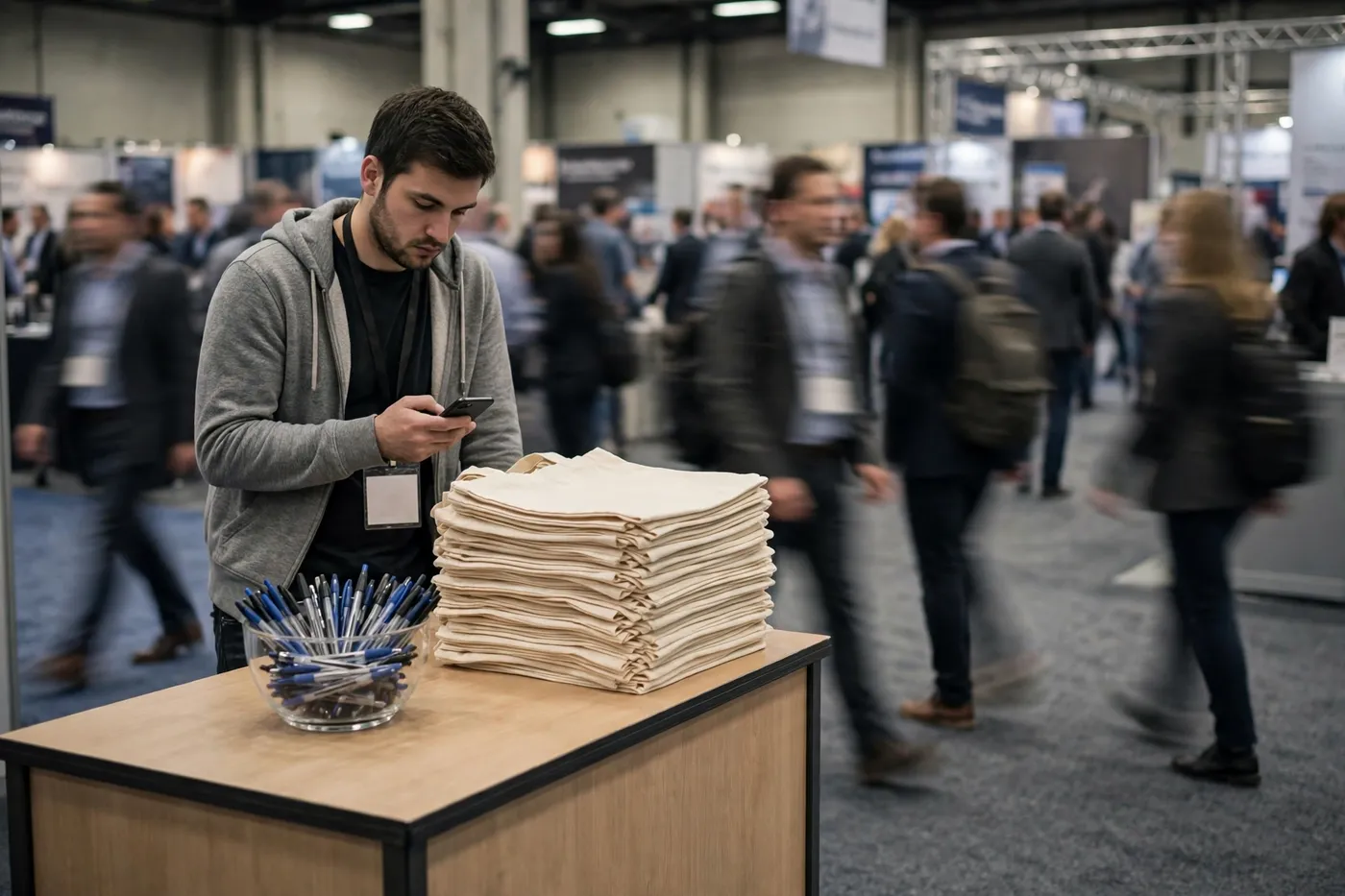
Here is the uncomfortable truth about the giveaway table: it is a filter, and it filters for the wrong people. The attendee who plans a route around free items is rarely the attendee with a budget and a problem. Meanwhile the people you actually want, the ones with buying authority and a full meeting schedule, are the most time-poor people in the building. They do not queue for a stress ball. They walk past it at speed, on the way to an appointment.
The grab-and-go interaction takes about ten seconds and produces zero conversation. Worse, the incentives are pointed in opposite directions. The attendee's goal is the item, obtained as fast as possible. Your goal was the meeting. So your staff spends the show scanning the badges of people whose only buying intent in your booth was for a free tote bag, and your lead report fills up with names that look like pipeline and behave like confetti. When sales complains that trade show leads are cold, this is usually why.
The swag hunter is a known species
Ask anyone who has worked a booth for a decade and they can describe him: conference bag already full, eyes scanning counters rather than displays, opening line a variant of "what are you giving away?" He is not a villain and he might even work at a company in your market. But he is not at your booth to learn anything, and building your booth strategy around attracting more of him is how a five-figure exhibit budget turns into a very efficient merchandise disposal program.
The honest case for swag, because there is one
Let us be fair before we bury anything. The promotional products industry has real research behind it. PPAI, the industry's trade association, reports that roughly nine in ten consumers can recall the branding on a promotional item they received, and ASI research puts the share who remember the advertiser at about 85 percent. A genuinely useful, well-made item kept on a desk for months is a cheap stream of impressions, and a thoughtful gift to an existing customer says something real about the relationship.
Notice what that research actually proves, though: recall. A logo remembered is not a conversation held, a problem understood, or a lead qualified. Recall is the floor of what marketing is supposed to do, and swag hits that floor for the minority of items that get kept, while the rest join the estimated 40 percent that get thrown away. (The humble pen is the extreme case: the EPA has estimated that more than 1.6 billion disposable pens are thrown away in the United States every year.) Swag is fine. It is a supporting act with a decent memory trick. The mistake is billing it as the headliner.
What swag really costs: the full ledger
Swag also looks cheaper than it is, because the invoice for the items is only the first line of the bill. Run the whole ledger for a typical mid-size program, 500 decent items, one show:
- The items. 500 branded bottles, bags, or notebooks at $5 to $8 each is $2,500 to $4,000 before anything moves.
- Freight to the show. Cases of merchandise are heavy, and heavy is what freight charges for.
- Material handling at the venue. Shows charge to receive, store, and deliver your freight to your booth, priced by weight. Your swag pays rent the moment it arrives.
- Staff time. Someone packs it, tracks it, unpacks it, rebuilds the display every morning, and manages the dwindling pile so the table never looks empty or picked over.
- The leftovers. Whatever survives gets shipped back at full freight, then stored. Warehousing and handling for idle inventory is commonly estimated to add around 25 percent of its value per year, rent on merchandise nobody wants, until someone finally authorizes the dumpster.
- The over-order. Running out looks bad, so everyone orders 20 to 30 percent more than they need, which guarantees the leftover problem above.
The swag ledger · one show, 500 items (illustrative)
Illustrative numbers for a mid-size program. Your figures will vary. The shape of the bill will not: you pay to buy it, pay to move it, pay to move it back, and most of it starts no conversations at all.
Add it up honestly and the modest swag program lands in the same range as a custom event game, before it has started a single conversation. That comparison deserves a table, because it is the whole argument in one view:
| The swag program | A custom event game | |
|---|---|---|
| Cost to buy | Thousands, every show, plus over-ordering | Once, from about $5,000, hosted for a year of events |
| Cost to ship | Freight plus venue material handling, by weight | Zero. It is a link. |
| Cost to ship back | Full freight again, plus storage on leftovers | Zero. There is nothing physical to return. |
| Stops traffic | Only the freebie hunters | Motion, light, sound, and a crowd watching a score |
| Starts conversations | "What are you giving away?" | "Think you can beat 6,500?" |
| Teaches your story | A logo, if it is kept | The game is built from your products, your market, and your customer's problem |
| Lead quality | A badge scan and a tote bag | Name and phone given willingly, with score and answers attached |
| After the show | A drawer, a donation bin, or a landfill | Still playable online, on any phone, shareable with the whole office |
Why a game stops traffic
A game on a big screen is alive in a way no static display is. It moves, it glows, it makes noise, and most importantly, it is being played by a person, which means it comes with the most reliable crowd magnet in events: other people watching. Attendees read a crowd as a review. A small knot of spectators around your screen tells the aisle that something here is worth their time, and spectators reliably convert into players, because watching someone else play creates the itch to do better.
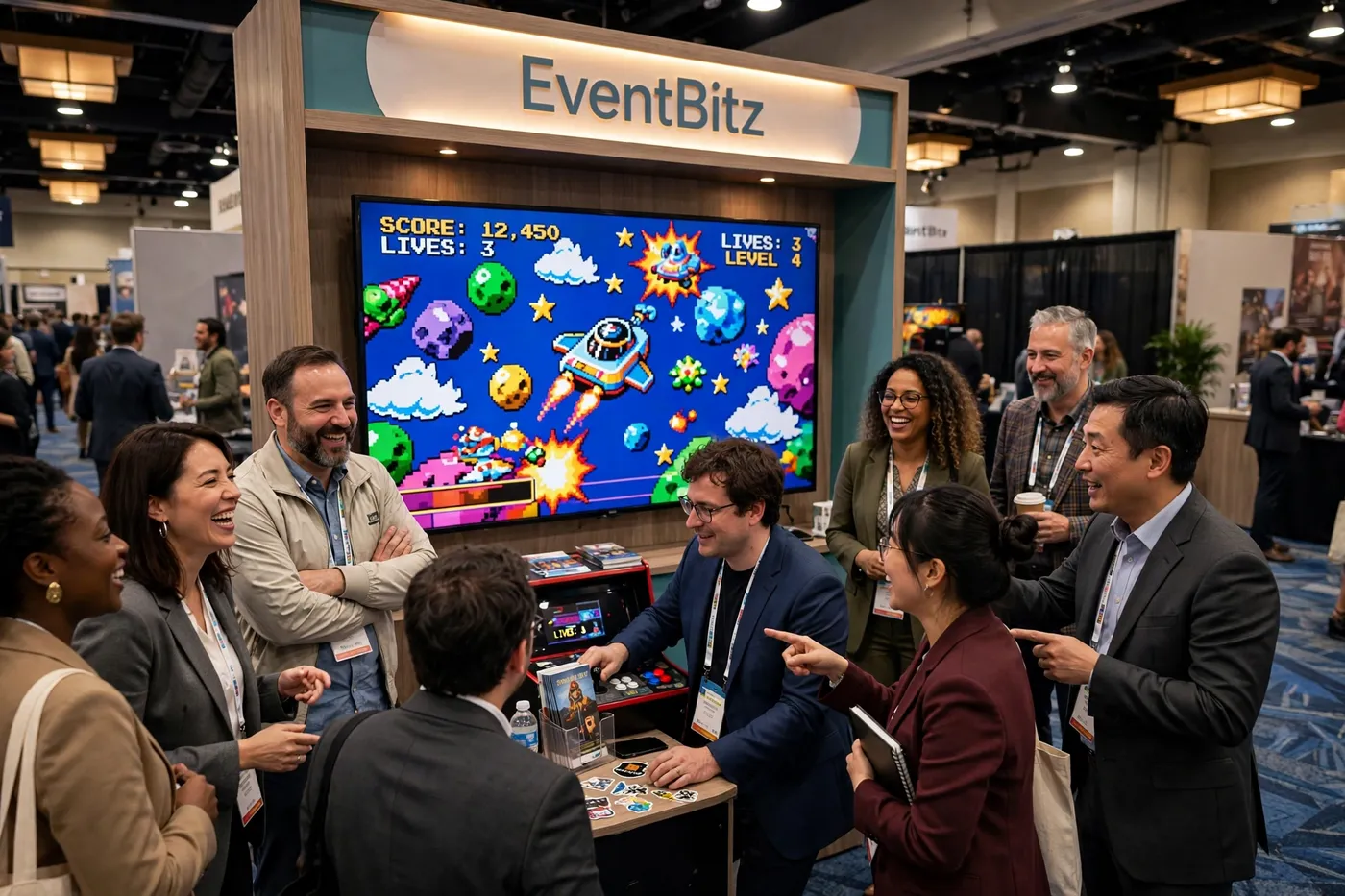
Arcade formats do the rest. A stacking game, a runner, a reaction challenge: these are nostalgic, instantly understood formats that need no explanation and no courage to try. There is no learning curve to be embarrassed by and no sales rep hovering with a clipboard. The visitor's guard is down because the situation is play, and a person whose guard is down is a person you can actually talk to. That is the moment the other three jobs become possible.
The icebreaker problem, solved
The hardest sentence in exhibiting is the first one. Booth staff dread it and attendees dodge it, because everyone knows the script: a stranger asks if they can help you, you say you are just looking, and the whole thing dies in four seconds. A game rewrites the script. The opener becomes a score to beat, a play to comment on, a near miss to laugh about. Your staff are no longer interrupting anyone. They are hosting something the visitor chose to do.
And the conversation that follows a run is warm in a way no cold approach is.
The visitor just spent one to three minutes inside your world, laughing, competing, maybe winning. Asking "which part got you?" or "want a rematch after I show you the two-minute version of what we do?" is natural in that moment. The pitch, when it comes, lands on someone who is already smiling and already knows your name, your colors, and the shape of your story, because they have been playing with all three.A game teaches while it entertains
This is the part a logo on a pen can never do, and it is the entire design philosophy behind the games we build at EventBitz. A custom event game is constructed, deliberately, out of the exhibitor's own material:
- The game pieces are the products and services. In one of our builds, attendees stack a technology company's service portfolio with their hands, so the catalog stops being a brochure and becomes something they have physically handled. (The full story: how we built a custom stacking game.)
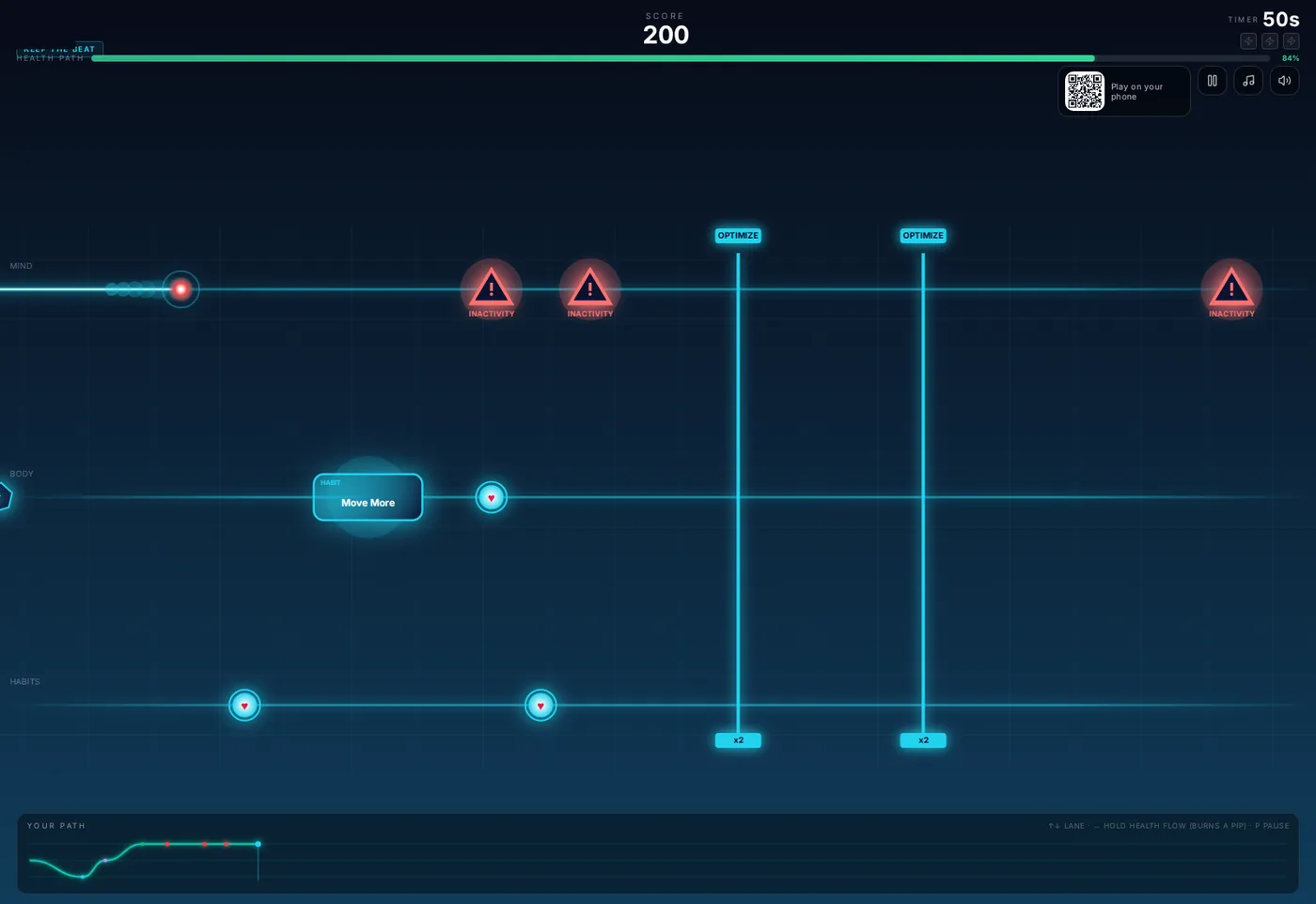
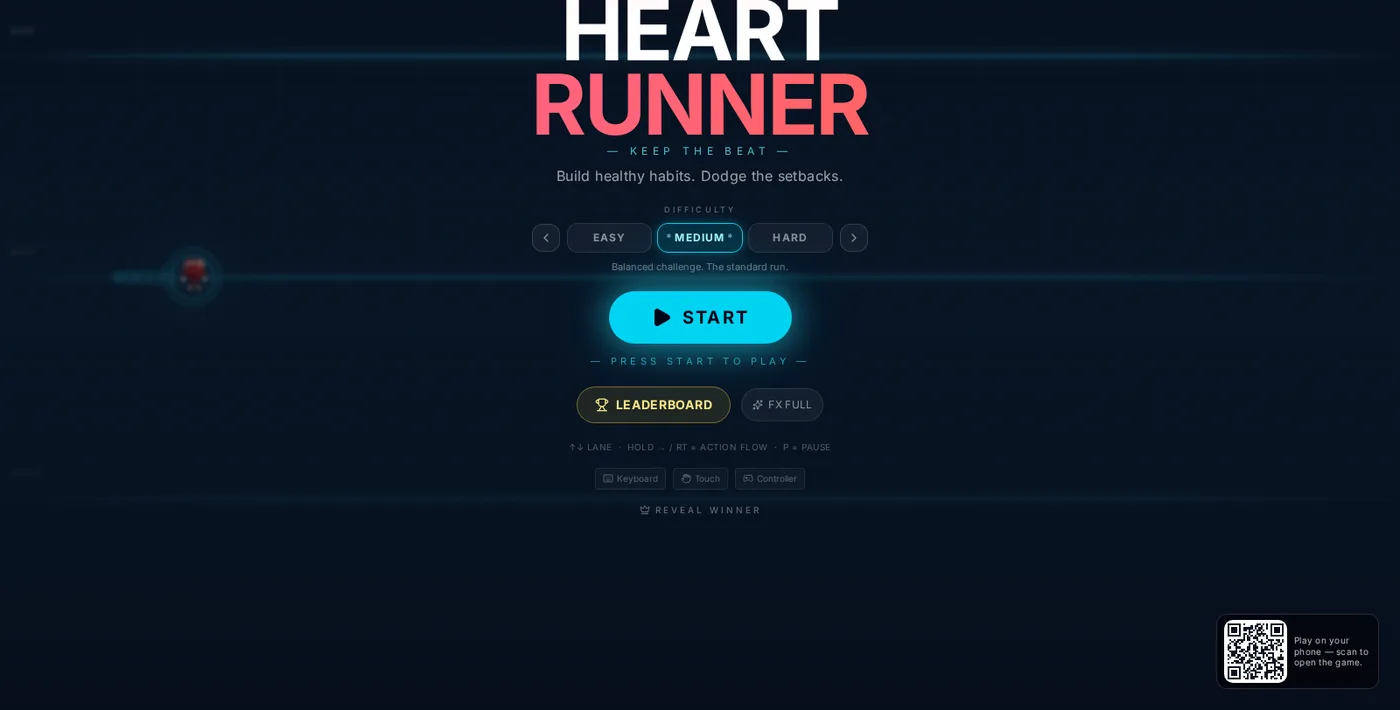
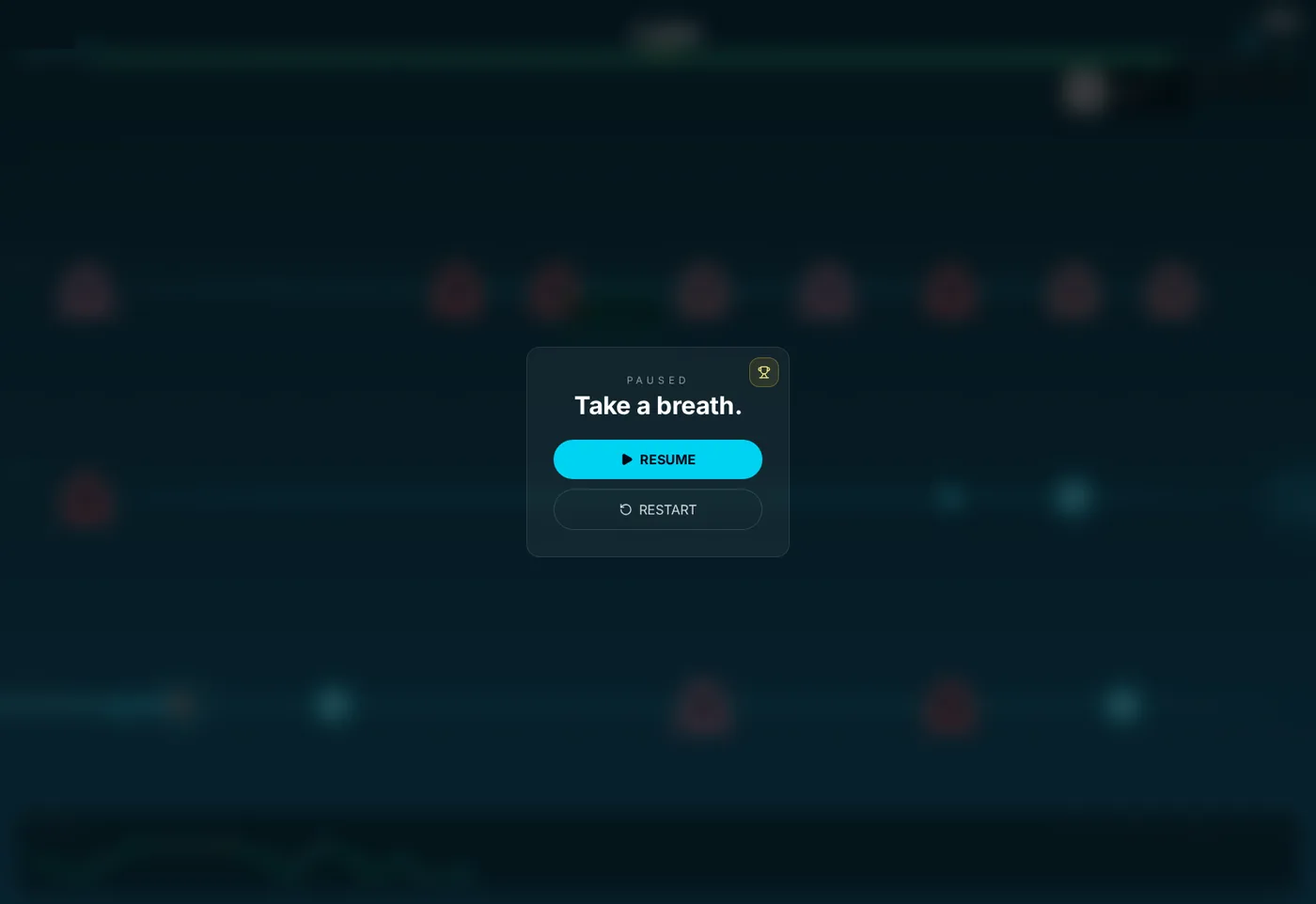
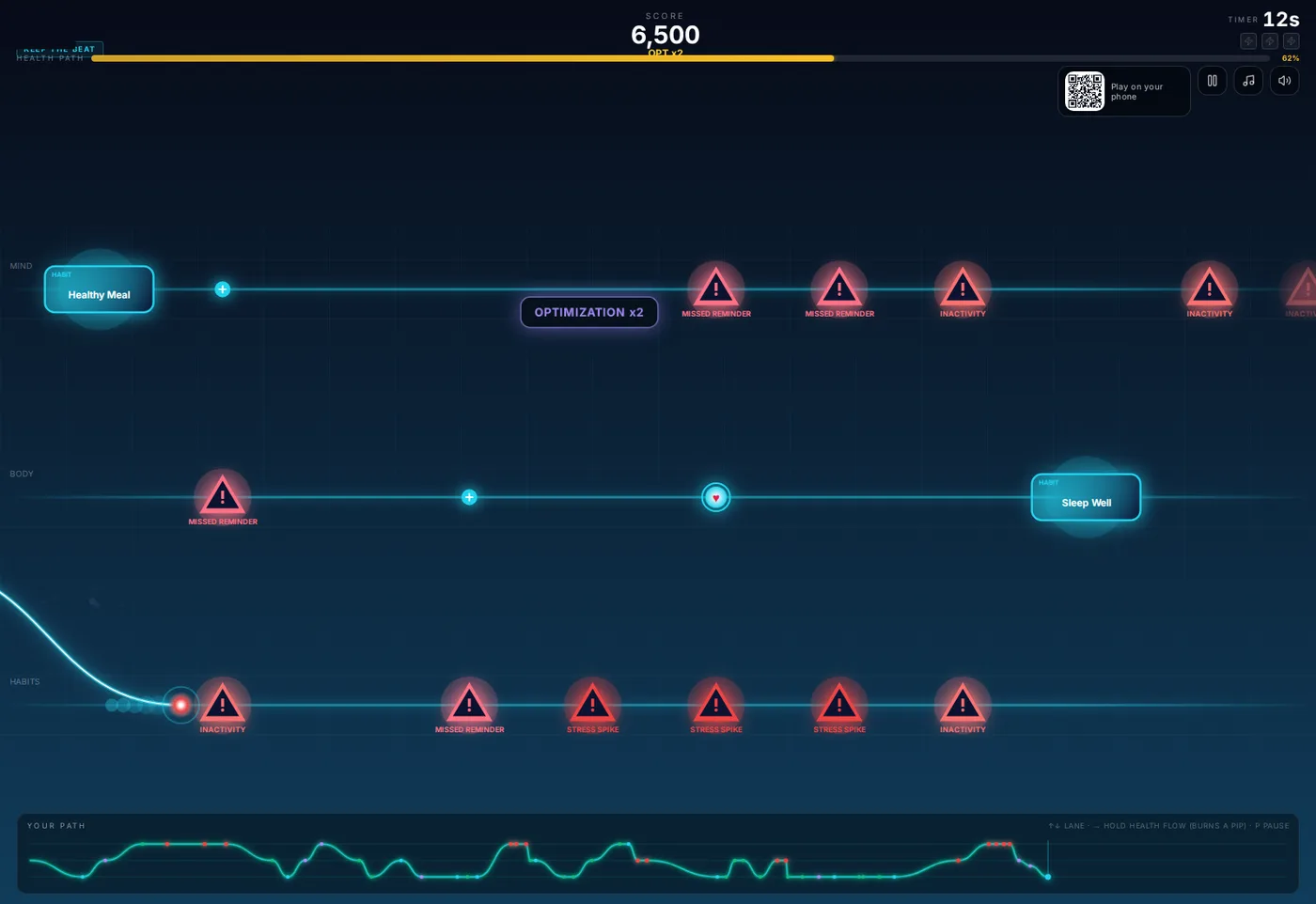
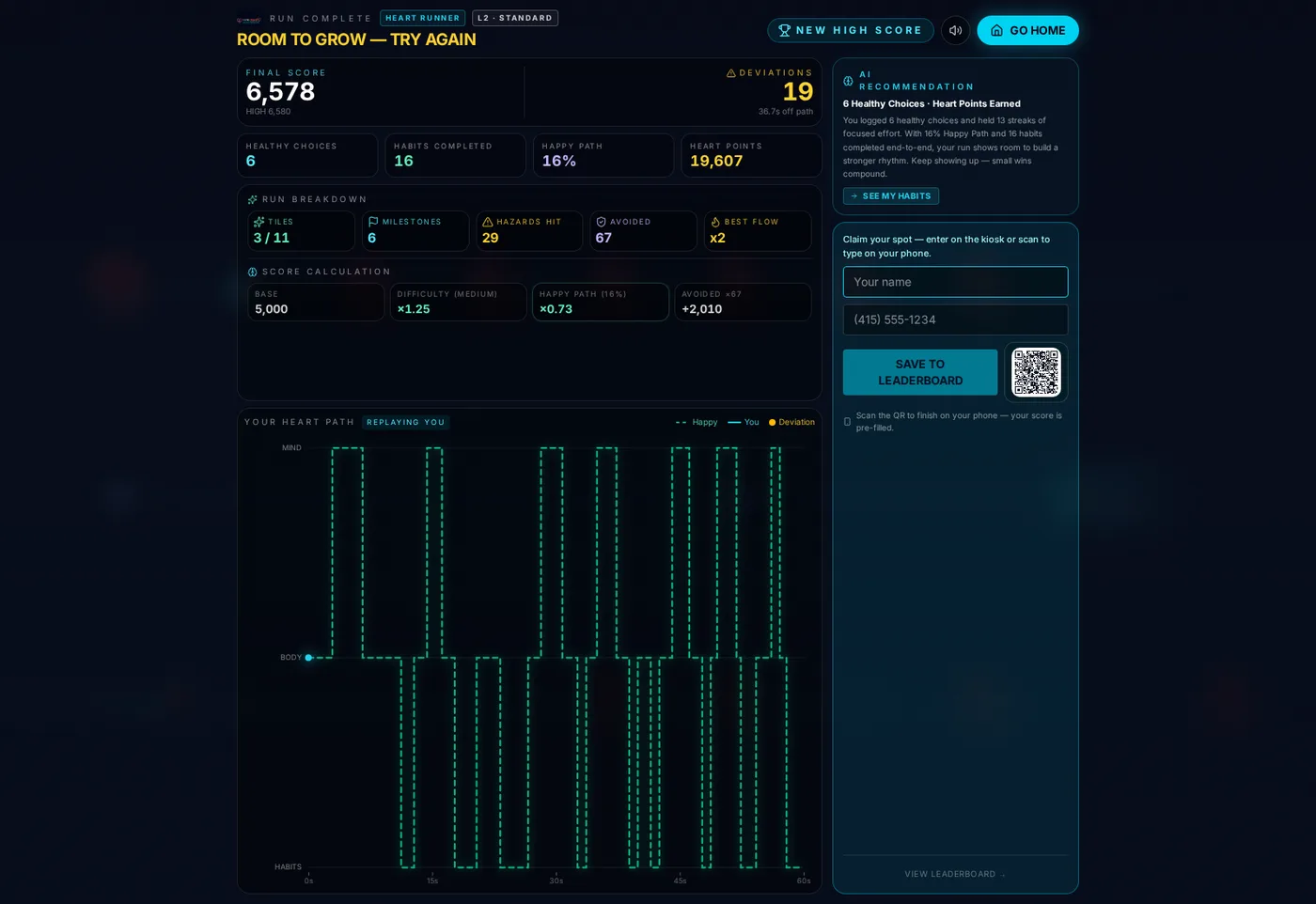
- The obstacles are the customer's problems. In our heart health runner, the hazards are the named setbacks that knock people off a healthy routine, so playing the game is rehearsing the client's argument about why their product exists. (How we built a heart health runner game.)
- The quiz layer asks real questions. Bonus questions after a round are written from the client's market and approved by the client, and they surface what the visitor knows, believes, and gets wrong, which is discovery data a badge scan will never give you.
- The results screen repeats the message. Score breakdowns, recaps, and recommendations restate the story at the moment of peak attention, when the player is reading everything on the screen because it is about them.
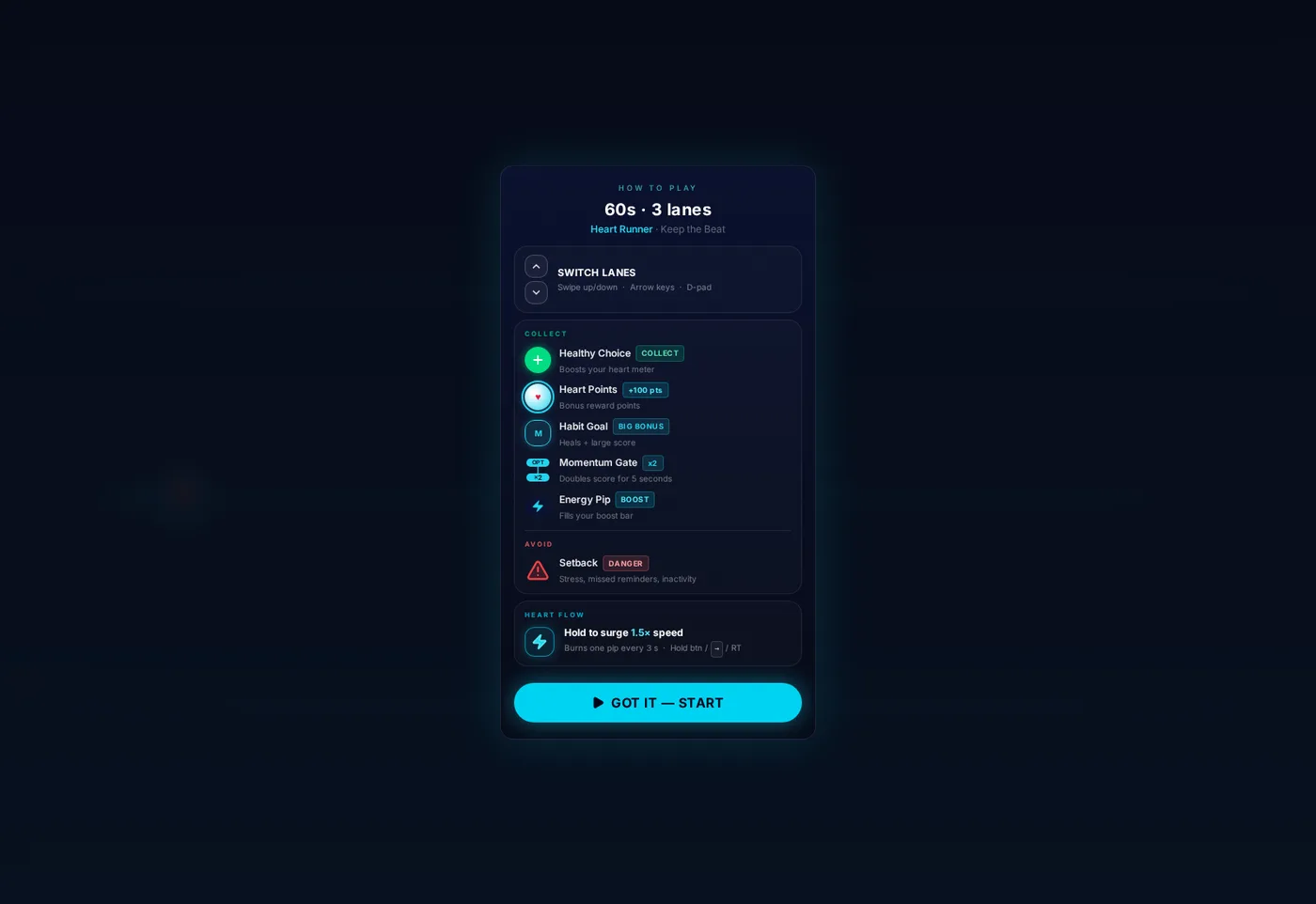
By the time a rep says hello, the visitor has already absorbed the outline of the pitch through their hands. The conversation can skip the brochure recital and start where selling actually happens: at the visitor's specific problem.
Competition turns a visit into a story
A leaderboard changes the physics of a booth. Now there is a score to beat, and it belongs to someone who played an hour ago, which makes it personal. Players come back for a second run between sessions, a genuine second touch that no other booth mechanic produces so reliably. They bring colleagues to watch, or to challenge. The day's high score becomes a running story your staff can tell every passerby, and the end-of-day winner moment, announced on the booth with a small prize, gives the crowd a finale and your team a photograph worth posting.
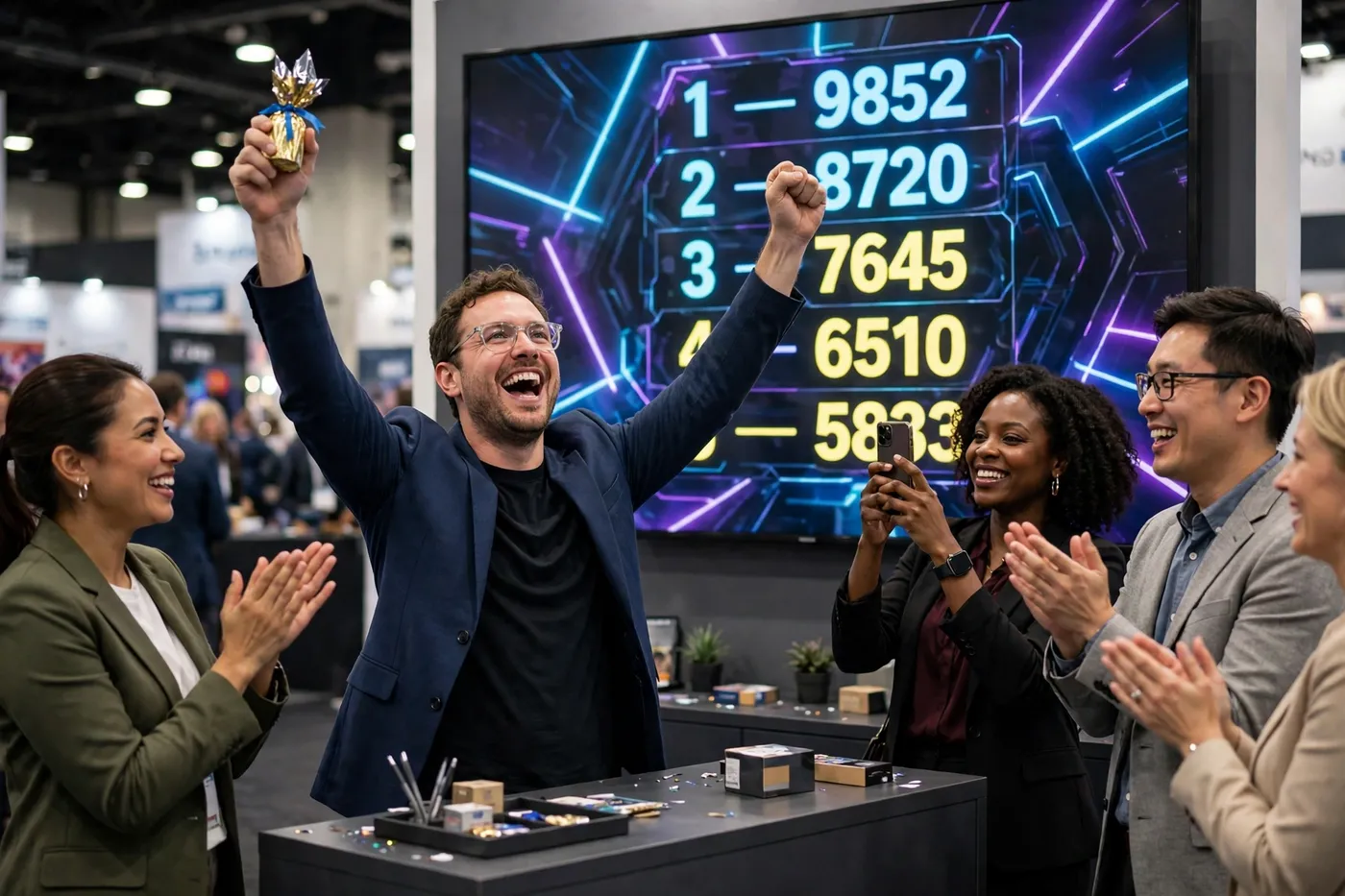
Stories are the currency here. Nobody has ever gone back to their office and narrated the pen they picked up. People absolutely narrate the game they nearly won, the colleague who beat them by 200 points, and the rematch they are owed. EventTrack's consumer research consistently finds that the overwhelming majority of attendees who tell someone about an event experience mention the brand behind it. A game gives them something worth telling, with your name attached to the fun part.
of consumers say engaging with a branded experience makes them more likely to buy the promoted products (EventTrack)
of attendees who tell someone about an event mention the brand behind the experience (EventTrack)
of one-time buyers at live experiences become repeat customers (EventTrack)
From play to pipeline: what an MQL actually looks like
Now the fourth job, the one the whole exhibit budget is supposedly for. A marketing qualified lead is not a name. It is a name attached to evidence: this person fits our market and has shown real interest. Compare the two captures side by side.
A badge scan gives you contact details and nothing else. No signal about interest, no record of a conversation, no reason for sales to call this person before the other 400 names. It is not a mystery that follow-up fails: Competitive Edge's exhibition research has long reported that 87 percent of trade show leads are never effectively followed up. Sales teams are not lazy. They are rationing effort across a pile of context-free names, and context-free names lose.
A game lead arrives with its story attached. The player registered a name and phone number voluntarily, at the moment of peak engagement, to claim a leaderboard spot or enter the high score giveaway. Attached to that lead: the game they played, their score, their quiz answers, and often a conversation your staff had during the run. The follow-up writes itself, and it does not sound like a cold call: "You finished second on Tuesday with 6,500 and nailed the question about onboarding time. Here is the two-minute version of how we fix exactly that." That is a message a prospect answers, from a person they remember, about a moment they enjoyed. That is what an MQL is supposed to be.
A badge scan gives you
- A name, a company, an email
- No record of interest or intent
- No conversation to reference
- A follow-up that sounds like a cold call
A game lead gives you
- Name and phone, given willingly at peak engagement
- A score, quiz answers, and what they played
- A shared moment your follow-up can open with
- Evidence of interest: the definition of an MQL
The afterlife: a link beats a tote bag
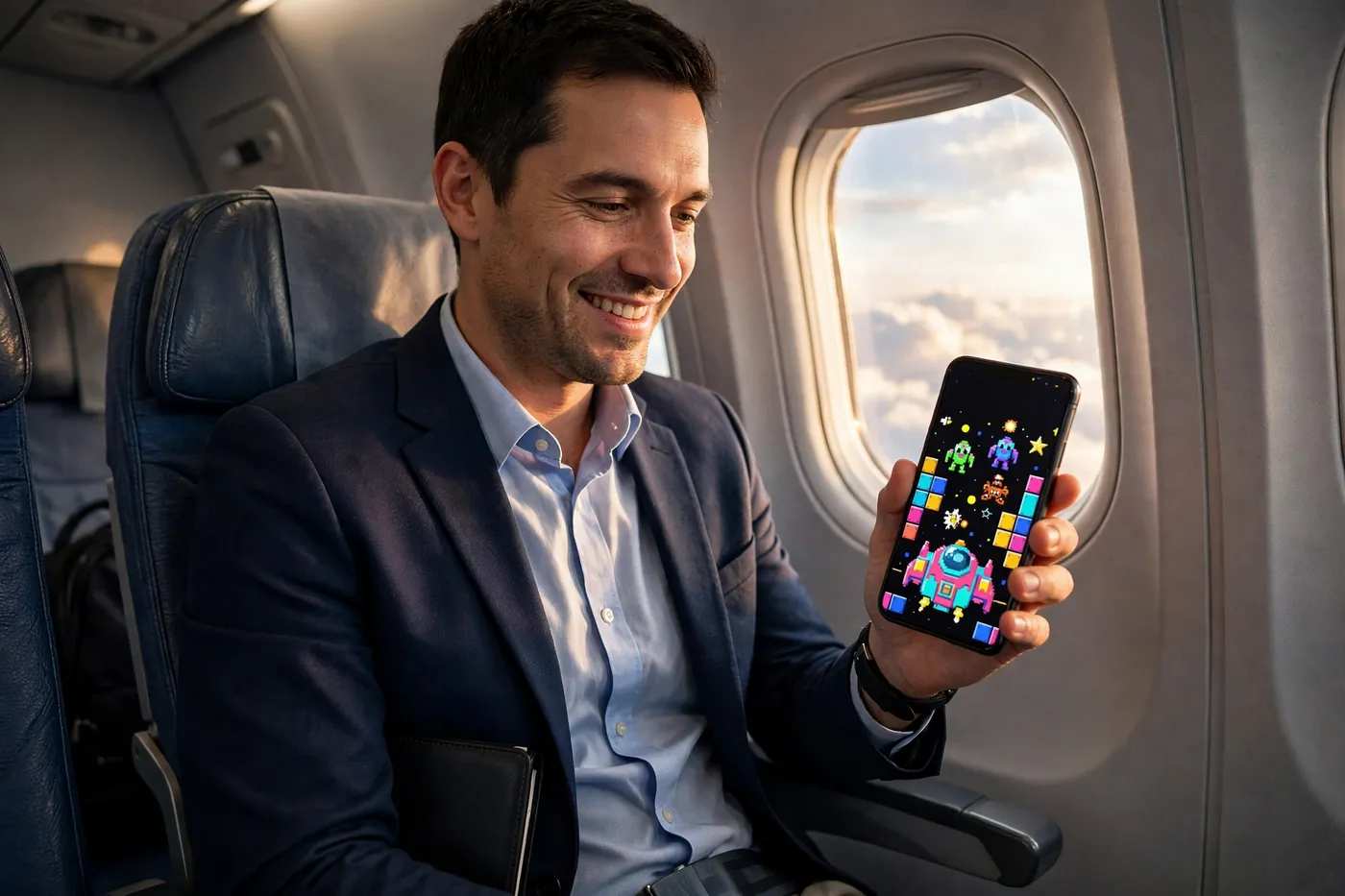
When the show ends, swag's story ends with it, in a suitcase, a drawer, or the bin by the hotel elevator. A game's story is just getting started. The same build that ran on your booth screen lives online. The visitor who played can scan a code, reopen it on their phone on the flight home, and, this is the part no physical object can do, forward it to the colleagues who were not at the show. Your booth experience walks into offices you never exhibited at, still teaching the same story, still carrying your leaderboard and your call to action.
It also runs at the next event, and the one after that, on the same foundation with refreshed content, for a year of hosting. It runs on any device your next venue happens to have. And it costs exactly nothing to ship, in either direction, forever, because there is nothing to ship. The freight line in your exhibit budget simply disappears.
So keep some swag. Just demote it.
The right conclusion is not a bonfire of branded merchandise. It is a change of rank. Let the experience be the attraction and let swag become the souvenir of the experience: the prize the day's winner holds in the photo, the quality item handed to a prospect after a real meeting as a thank-you, the thing that commemorates something instead of substituting for it.
That item now carries a memory, and the memory carries your name.
Budget follows rank. Spend first on the thing that stops traffic, starts conversations, teaches the story, and produces leads your sales team will thank you for. Then, with what is left, buy less swag and better swag, for the people who earned it by engaging. You will spend less on freight, throw less away, and finally be able to answer the question every exhibit manager dreads in the post-show review: what did we actually get for that?
A checklist for your next show
- Grade every planned booth element against the four jobs: attention, icebreaking, teaching, leads. Cut anything that does none of them well.
- Cut the mass giveaway order by at least half, and put the savings toward one real attraction.
- Choose an attraction with motion and a crowd: a playable game, a live challenge, a score to beat.
- Build the teaching into the attraction itself, from your products, your market, and your customer's problem.
- Capture leads inside the experience, at peak engagement, with context attached.
- Give your staff a script that starts with the game, not the pitch, and a follow-up template that references the play.
- Keep a small stock of genuinely good swag for winners and real meetings. Make it a trophy, not a toll.
- Make sure the experience lives online after the show, playable on a phone and shareable with people who never attended.
Questions exhibitors ask us
- Does swag ever make sense at a trade show?
- Yes, in a supporting role. A quality item given to a real prospect after a real conversation, or awarded as the prize for winning the booth game, earns its place. What no longer works is mass giveaway as the main attraction: it draws the grab-and-go crowd and produces badge scans instead of conversations.
- How does the cost of a custom event game compare to a swag program?
- A themed custom game starts at about $5,000, which is in the same range as a mid-size swag program once you count the items, freight to the show, venue material handling, and shipping the leftovers back. The difference is what remains afterward: the game keeps running online for a year of events, while the swag is gone or in a storage unit.
- Do games work for serious or technical audiences?
- Yes. The arcade format is the wrapper; the content carries the depth. A well-built event game teaches the product story through its mechanics and asks real questions about the attendee's world in its quiz layer. Engineers and executives compete just as hard as anyone, and they remember the game that treated them as smart.
- How do booth games capture leads?
- Players register a name and phone number to claim a leaderboard spot or enter the high score giveaway, at the moment they are most engaged. The lead arrives with context attached: their score, their quiz answers, and what they played. That context is what turns a contact into a marketing qualified lead your sales team will actually call.
- What does a booth need to run a game?
- A laptop, an HDMI cable, and a display, plus venue wifi. The games run in a browser on any device, and visitors can also play on their own phones by scanning a QR code. There is nothing to ship to the show and nothing to ship back.
Sources and further reading
- EventTrack consumer research (Event Marketer), as compiled in Experiential Marketing Statistics 2026: 98 percent of attendees more inclined to purchase after a live experience, 74 percent more likely to buy promoted products after engaging with a branded experience, and the finding that attendees who tell someone about an event overwhelmingly mention the brand behind it.
- PPAI and ASI promotional product research, as compiled in Promotional Product Statistics: roughly nine in ten consumers recall branding on a promotional item received, and about 85 percent remember the advertiser.
- On swag waste: Nonprofit Swag: Trash or Treasure? (about 40 percent of promotional goods estimated thrown away) and What Happens to Your Trade Show Swag? (the EPA's estimate of 1.6 billion disposable pens discarded yearly).
- Jefferson Davis, Competitive Edge, closed-loop lead management research: 87 percent of exhibition leads never effectively followed up.
Ready to retire the pen bowl?
Tell us what visitors should remember and we will build the game that makes them remember it. Start with a concept, browse playable concepts in the game portfolio, or read how a build actually comes together in the stacking game build story and the heart runner build story. For giveaway ideas that work, read our Trade Show Giveaway Ideas guide or Trade Show Swag Ideas guide.